Pyro Section – The Core of Cement Manufacturing
The Pyro Section is where raw materials are transformed into clinker through a complex interaction of heat, chemistry, and process control. It is the most critical and energy-intensive part of cement manufacturing, demanding both strong fundamentals and sharp operational understanding.
At barunsway, this section is built to bridge the gap between theoretical knowledge and real plant experience. It is designed not just to explain the process but to help you understand the system’s behaviour, interpret data, and make better operational decisions.
Whether you are a student preparing for the cement industry or a working professional aiming to improve plant performance, this platform provides practical, experience-driven insights that are rarely available in textbooks.
What Makes This Section Valuable
🔹 Connects theory with real plant conditions
🔹 Focuses on practical understanding, not just concepts
🔹 Helps in process optimization and troubleshooting
🔹 Builds confidence in analyzing kiln performance and data
Key Learnings
🔹 Understanding of preheater, calciner, kiln, and cooler operations
🔹 Fundamentals of combustion, heat transfer, and reaction zones
🔹 Methods to improve kiln stability and fuel efficiency
🔹 Identification and handling of common operational problems
🔹 Insights into clinker quality and process control
Why It Matters
A strong command of the Pyro Section enables you to control the most critical part of cement manufacturing, leading to improved efficiency, stable operations, and higher product quality.
This is not just learning; this is developing the mindset of a process engineer.
Overview of Pyro Section in Cement Manufacturing
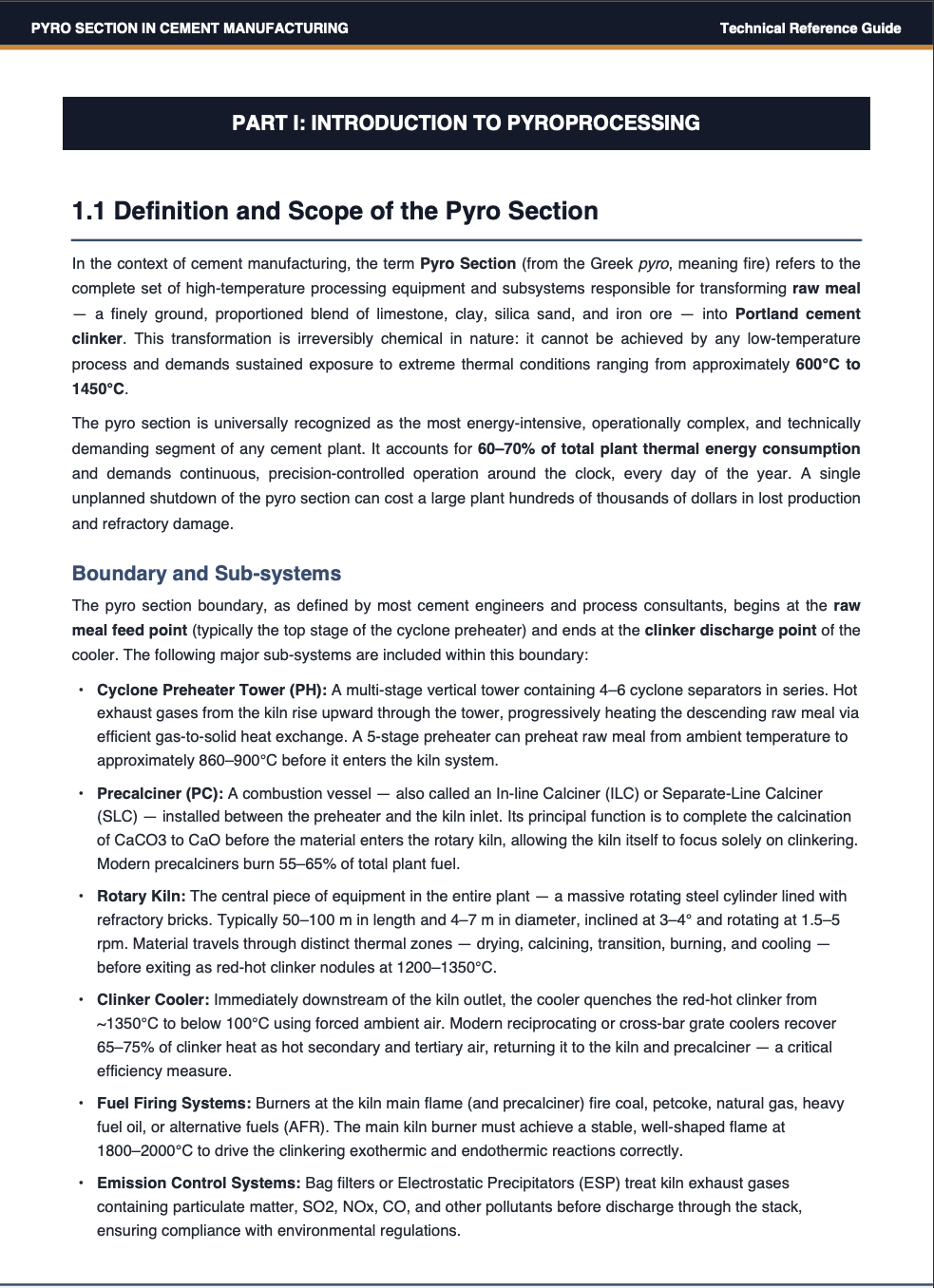
Definition and Scope of the Pyro Section
Key Concepts – Pyro Section in Cement Manufacturing
- The pyro section is the heart of cement manufacturing, where raw meal is transformed into clinker at temperatures up to 1450°C.
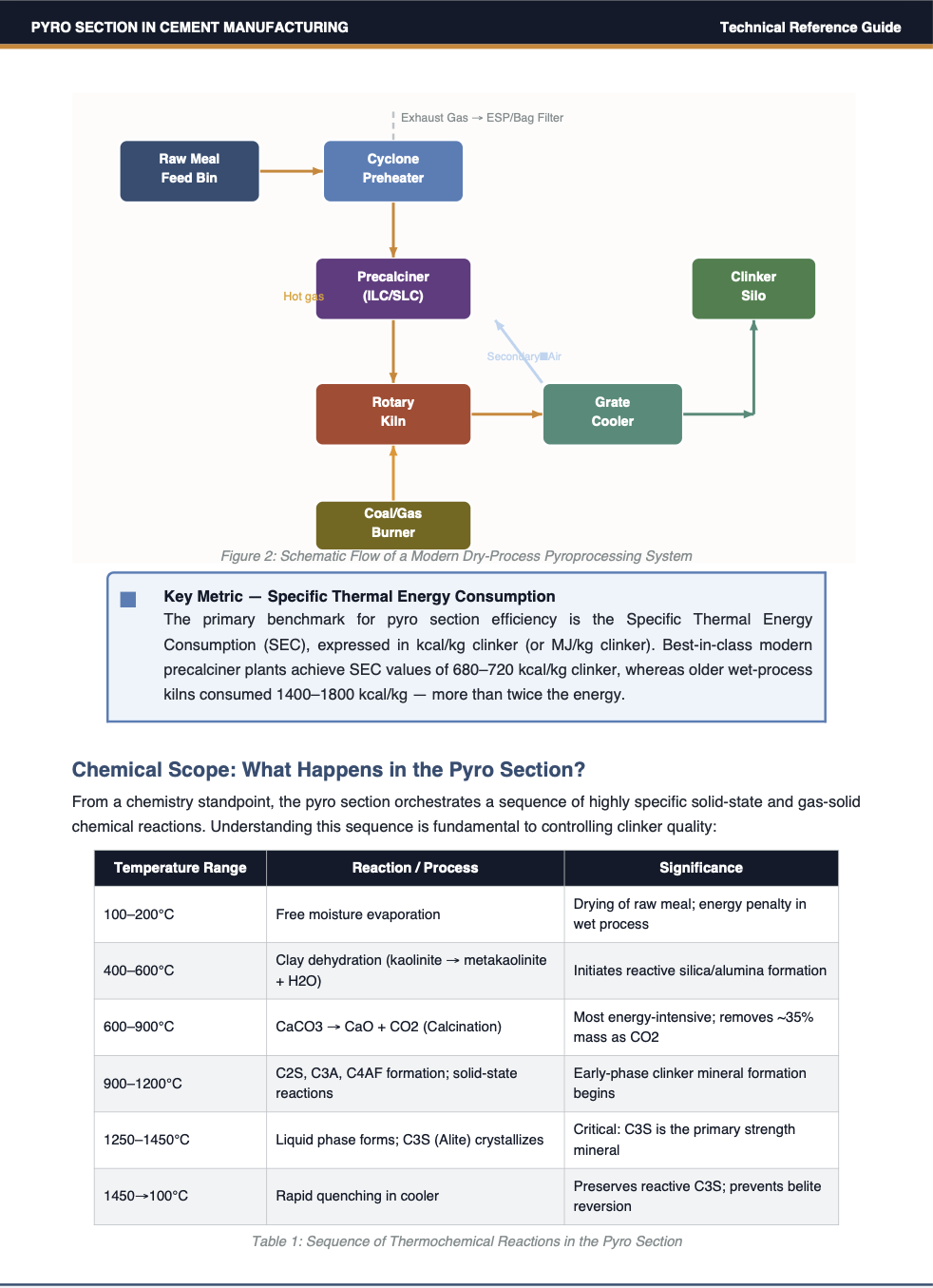
- It consists of major equipment like the Cyclone Preheater, Precalciner, Rotary Kiln, and Clinker Cooler, all working in an integrated system.
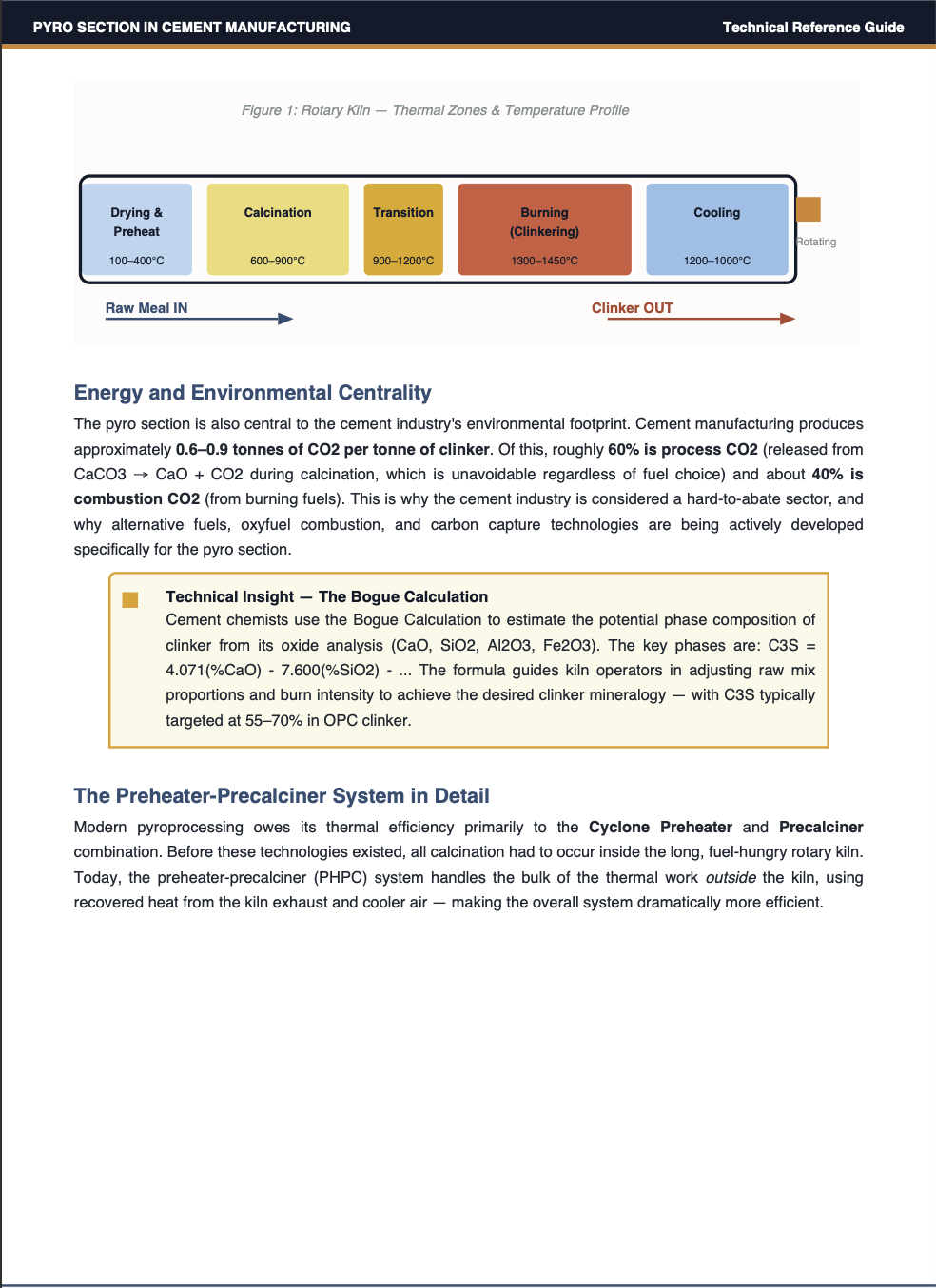
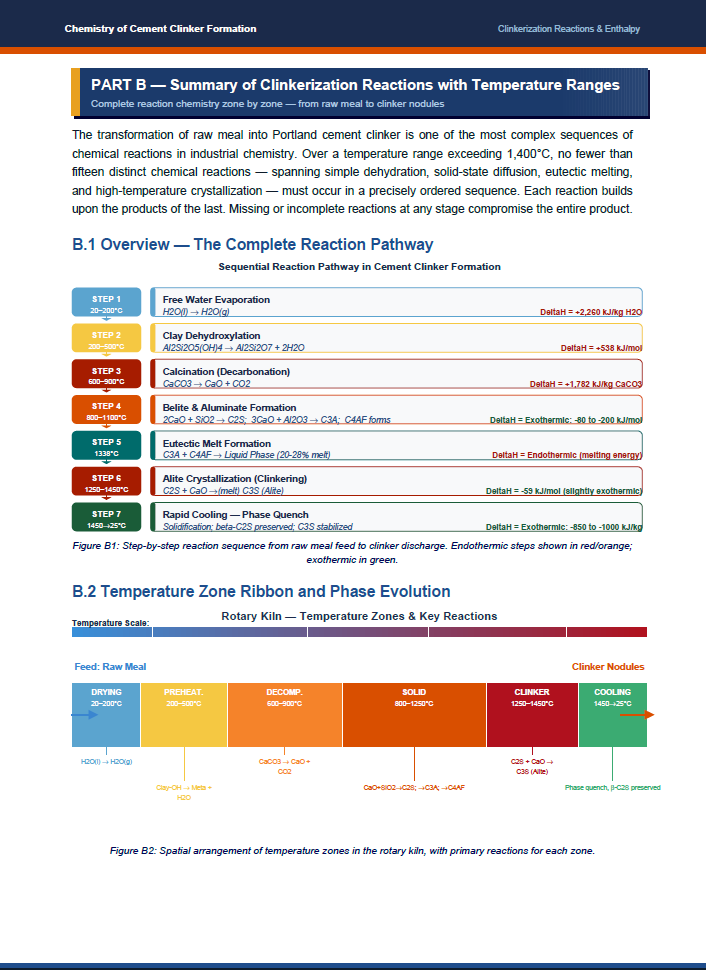
- The process follows a sequence of stages: drying → calcination (CaCO₃ to CaO) → clinker formation → rapid cooling.
- Formation of key clinker minerals such as C3S (Alite), C2S, C3A, and C4AF determines cement quality and strength.
- It is the most energy-intensive part of the plant, consuming around 60–70% of total thermal energy.
- Efficiency is measured by Specific Thermal Energy Consumption (SEC), with modern plants achieving much lower values.
- Advanced systems recover heat from hot clinker to improve energy efficiency and sustainability.
- Continuous operation and precise control are critical to avoid production losses and quality issues.
- Environmental systems like ESP/Bag Filters help control emissions such as dust, NOx, and CO₂.
Pyroprocessing: The Heart of Cement Manufacturing
Key Concepts – Pyroprocessing (Heart of Cement Manufacturing)
- Pyroprocessing is the core of the cement plant, where clinker is produced — the essential material that gives cement its binding properties.
- The entire plant revolves around the pyro section, as all upstream and downstream processes support it.
- High-temperature reactions (600–1450°C) create essential clinker minerals like C3S (Alite), C2S, C3A, and C4AF, which are responsible for cement strength and performance.
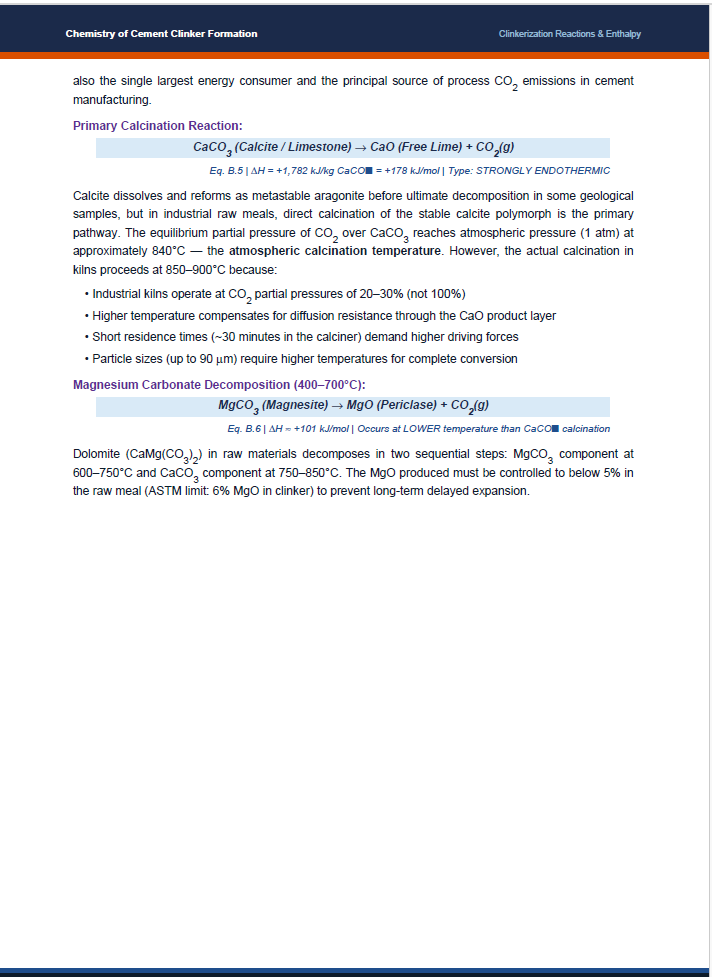
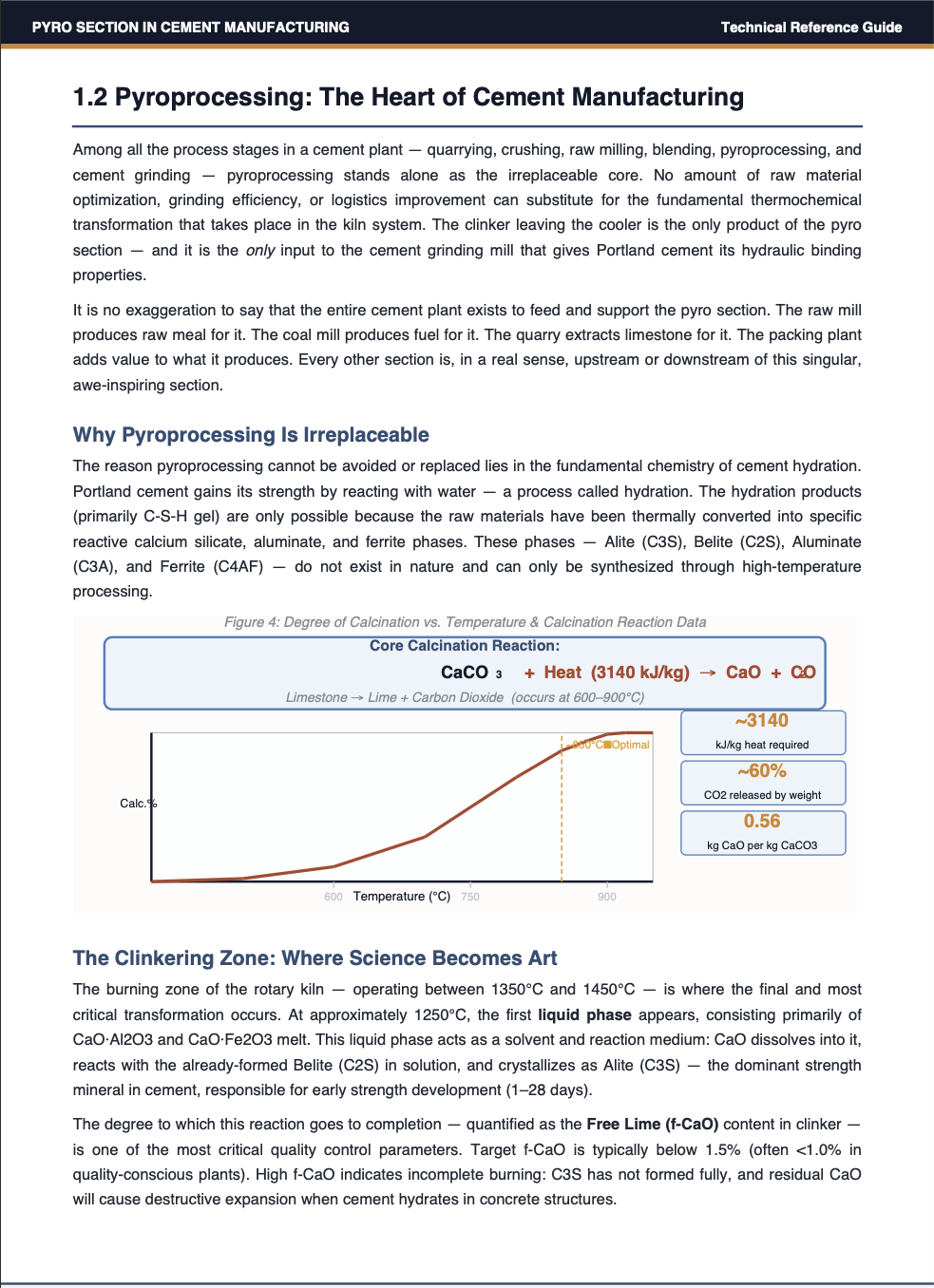
- Calcination (CaCO₃ → CaO + CO₂) is a critical and energy-intensive reaction, releasing a major portion of CO₂ emissions.
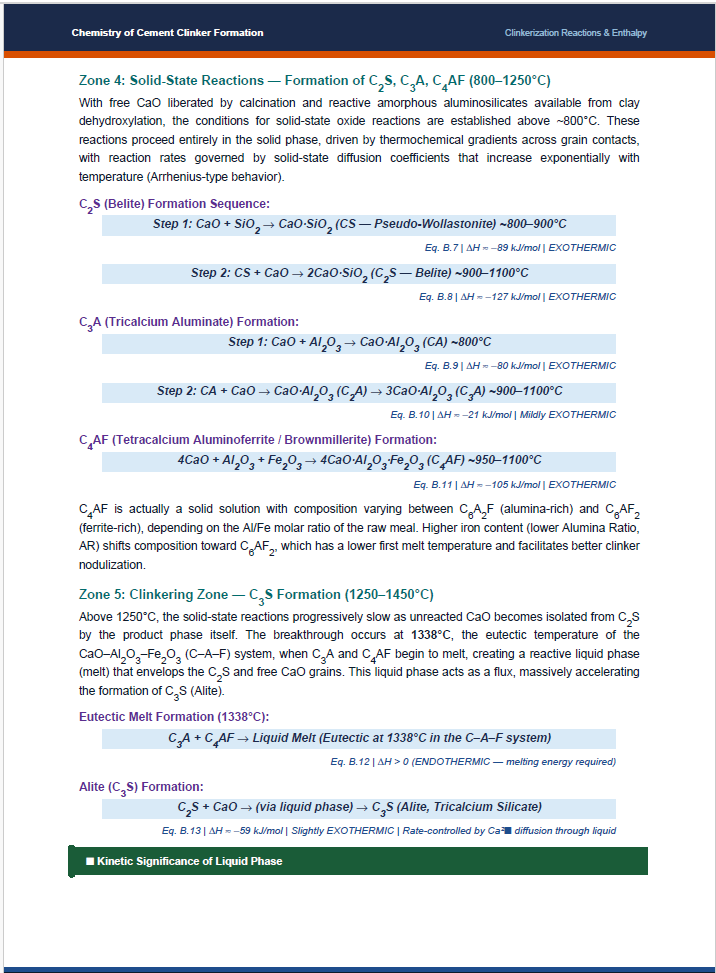
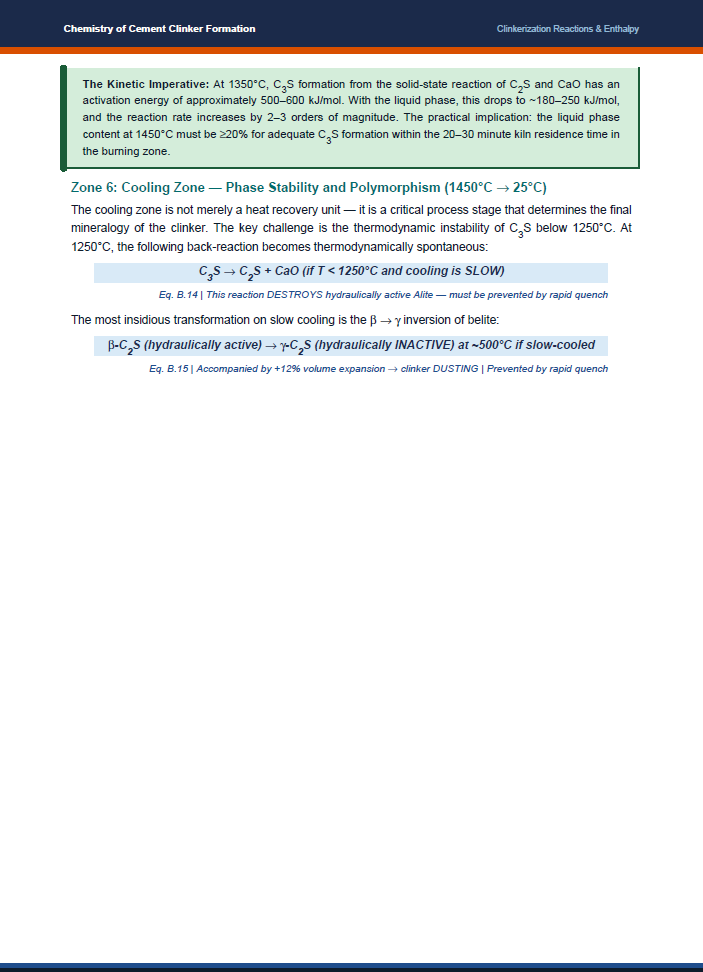
- The clinkering (burning) zone is where liquid phase formation enables the conversion of C2S into C3S, the most important strength-giving compound.
- Free Lime (f-CaO) is a key quality parameter — high values indicate incomplete reactions and poor clinker quality.
- The pyro section is a major source of CO₂ emissions (0.6–0.9 ton per ton of clinker), making it central to sustainability challenges in cement manufacturing.
- Modern systems use Cyclone Preheater and Precalciner technology to recover heat efficiently and reduce fuel consumption.
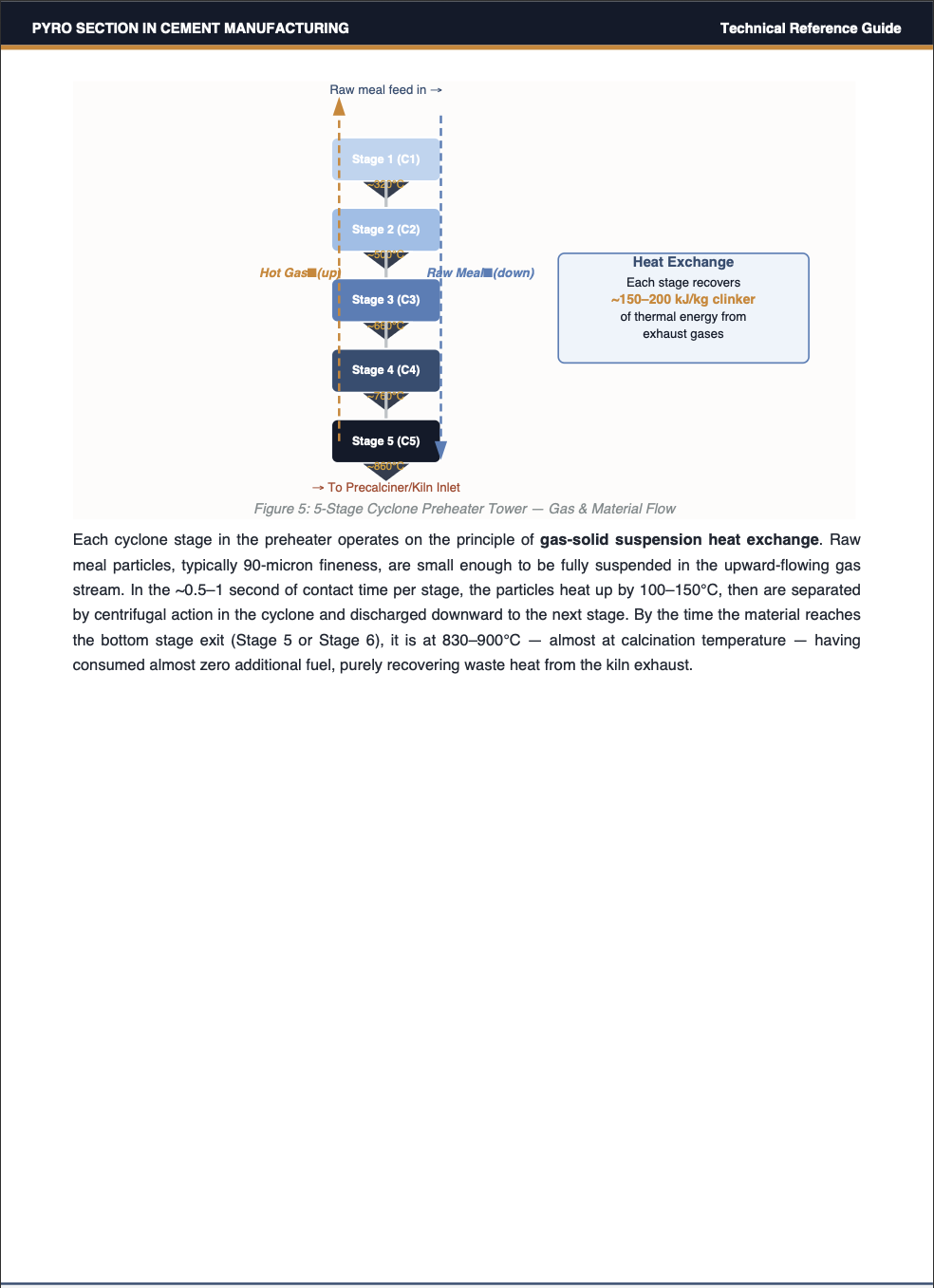
- Multi-stage preheaters significantly improve efficiency by heating raw meal up to ~900°C using waste exhaust gases before entering the kiln.
- Tools like the Bogue Calculation help control clinker composition and ensure desired cement quality.
Historical Evolution: Shaft Kilns to Modern Precalciner Systems
Key Concepts – Evolution of Pyroprocessing Technology
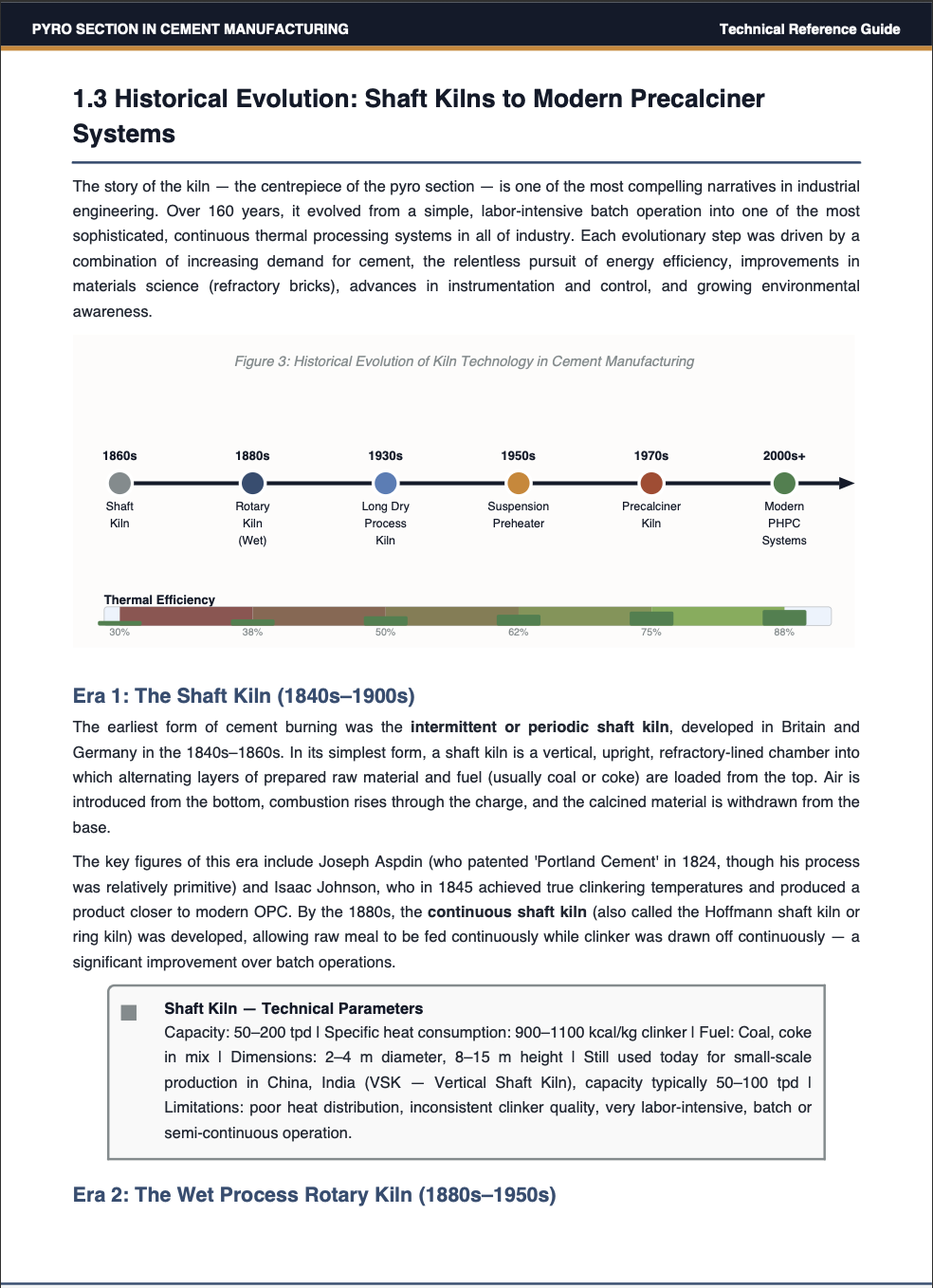
- Cement pyroprocessing has evolved over 150+ years from simple shaft kilns to highly efficient modern precalciner systems.
- Early shaft kilns were small, energy-intensive, and produced inconsistent clinker, suitable only for limited production.
- The invention of the rotary kiln revolutionized cement manufacturing, enabling continuous operation and large-scale production.
- Wet process kilns improved raw mix uniformity but consumed very high energy due to water evaporation.
- Transition to dry process kilns reduced energy consumption significantly by eliminating moisture from the process.
- The introduction of the cyclone preheater was a major breakthrough, allowing efficient heat exchange and reducing kiln size and fuel use.
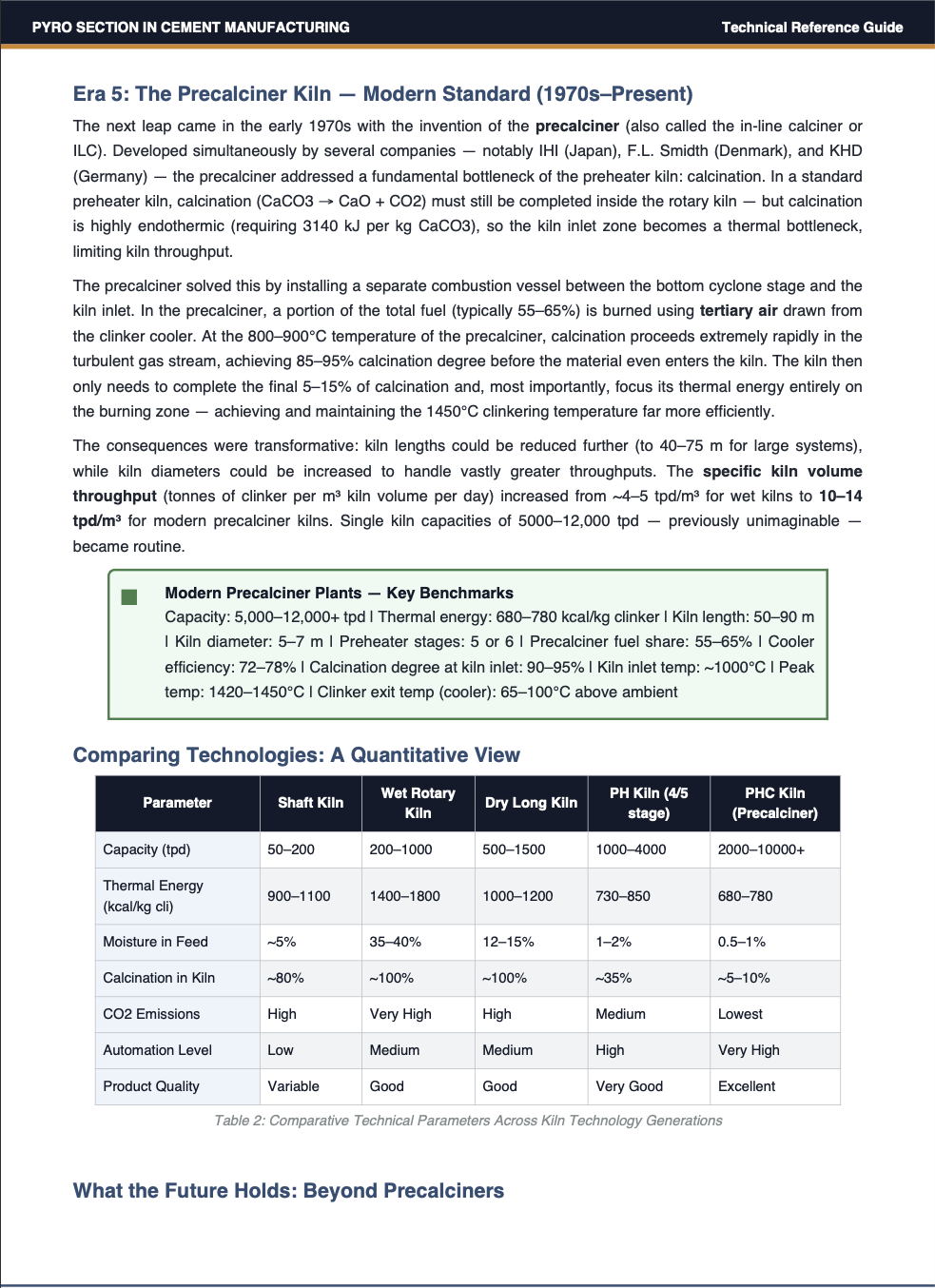
- Modern precalciner systems perform most of the calcination before the kiln, increasing capacity, efficiency, and control.
- Today’s plants achieve high production rates (5000–12,000+ TPD) with much lower energy consumption (~680–780 kcal/kg clinker).
- Continuous improvements have led to better automation, product quality, and reduced CO₂ emissions over time.
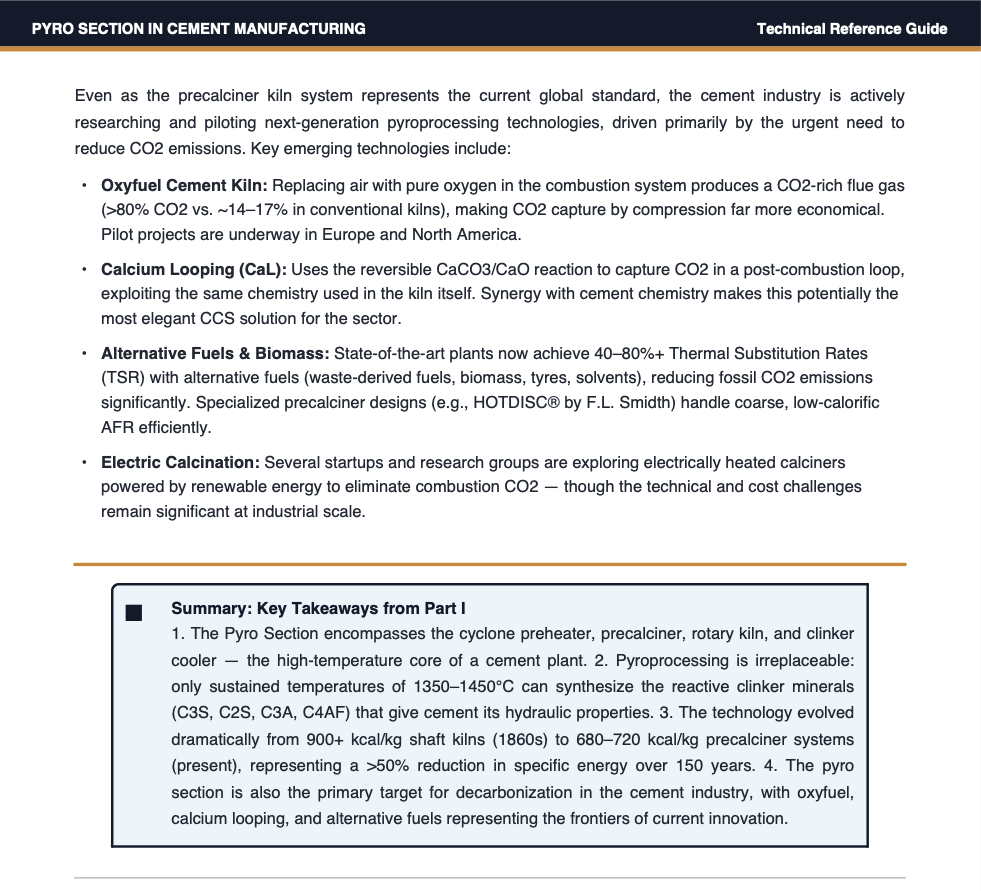
- The pyro section remains the main focus for future innovations, including:
- Alternative fuels and biomass
- Oxyfuel combustion
- Carbon capture technologies
- Electrification of calcination
Introduction To Pyroprocessing
Key Concepts – Pyro Section in Cement Manufacturing
- Understanding Pyroprocessing:
Learn how raw meal is transformed into clinker through high-temperature processes like preheating, calcination, sintering, and cooling. - Core Chemical Reactions:
Clear insight into stepwise reactions—from moisture evaporation to formation of key clinker minerals like Alite (C₃S) and Belite (C₂S). - Temperature Profile & Process Stages:
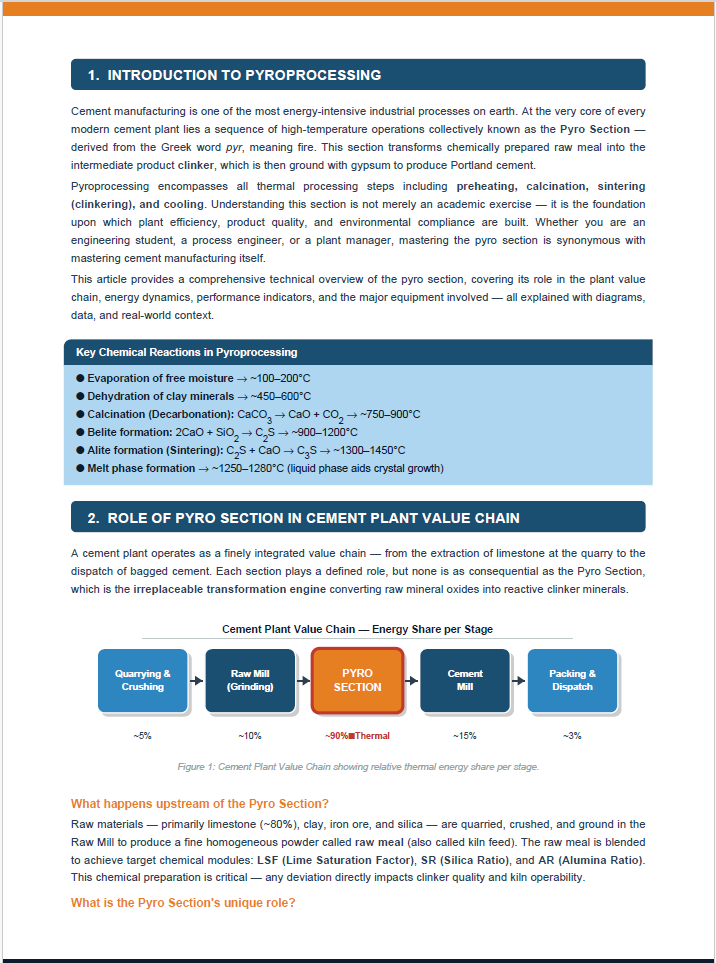
Knowledge of how temperature progressively increases (100°C to 1450°C) and its impact on material transformation. - Role in Cement Plant Value Chain:
Understand why the pyro section is the heart of cement manufacturing, contributing ~90% of total thermal energy consumption. - Raw Material Preparation Importance:
Learn how proper control of LSF, SR, and AR directly affects kiln performance and clinker quality. - Clinker Mineralogy & Its Impact:
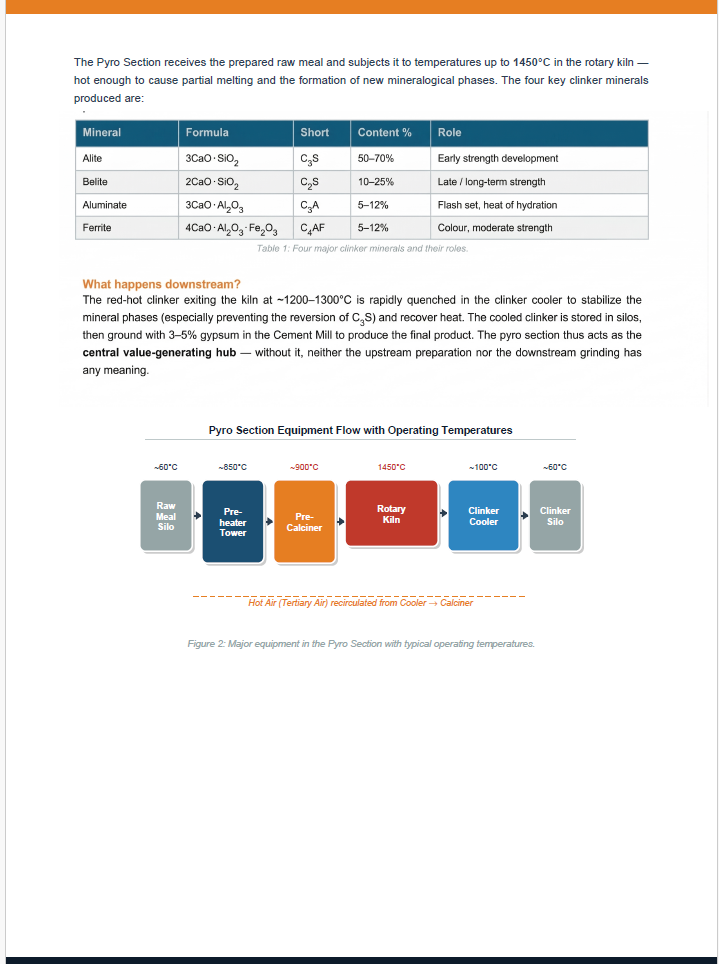
Gain clarity on the four major clinker minerals and how each influences cement properties like strength, setting time, and durability. - Equipment Flow & Functionality:
Overview of major equipment: Preheater, Precalciner, Rotary Kiln, and Clinker Cooler, along with their operating temperatures. - Heat Recovery & Efficiency:
Understand how heat is recovered (e.g., tertiary air from cooler) to improve energy efficiency. - Clinker Cooling & Stabilization:
Learn why rapid cooling is critical to preserve clinker quality and prevent phase reversion. - End-to-End Process Integration:
See how upstream (raw mill) and downstream (cement mill) processes depend on the efficiency of the pyro section.
ENERGY CONSUMPTION: PYRO SECTION AS 90% OF THERMAL ENERGY
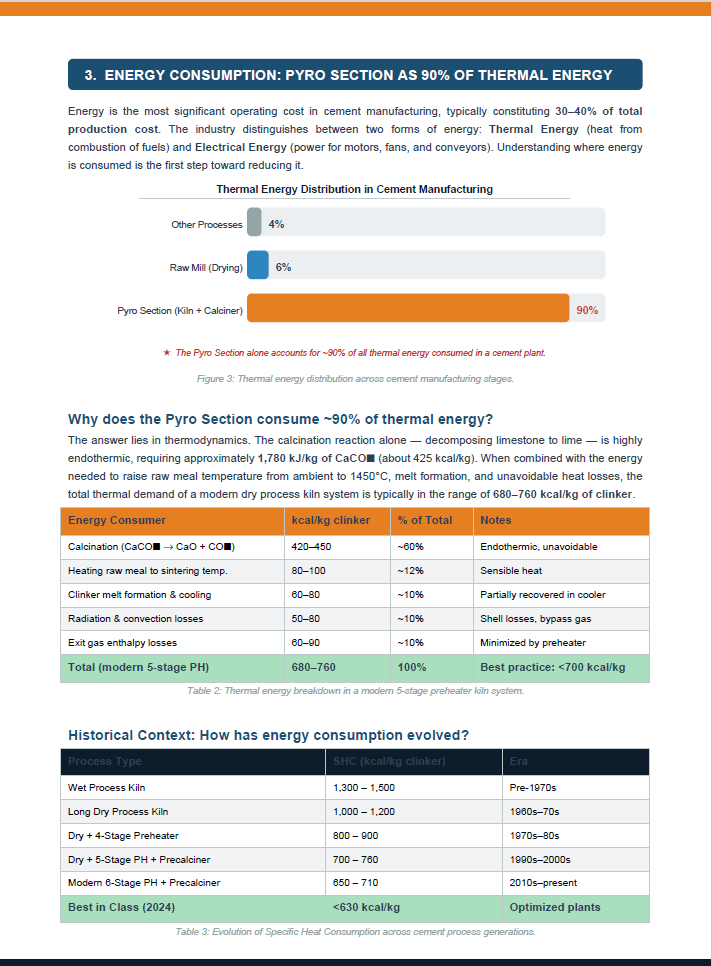
Key Concepts – Energy Consumption in Pyro Section
- Dominance of Thermal Energy Usage:
Understand that the pyro section alone consumes ~90% of total thermal energy in a cement plant, making it the most energy-intensive stage. - Thermal vs Electrical Energy:
Clear distinction between heat energy (fuel combustion) and electrical energy (equipment operation). - Why Energy Demand is So High:
Learn the thermodynamic reason behind high fuel consumption—especially the highly endothermic calcination process. - Detailed Energy Breakdown:
Insight into where energy is spent:- Calcination (~60%)
- Heating raw meal (~12%)
- Clinker formation & cooling (~10%)
- Heat losses (~20%)
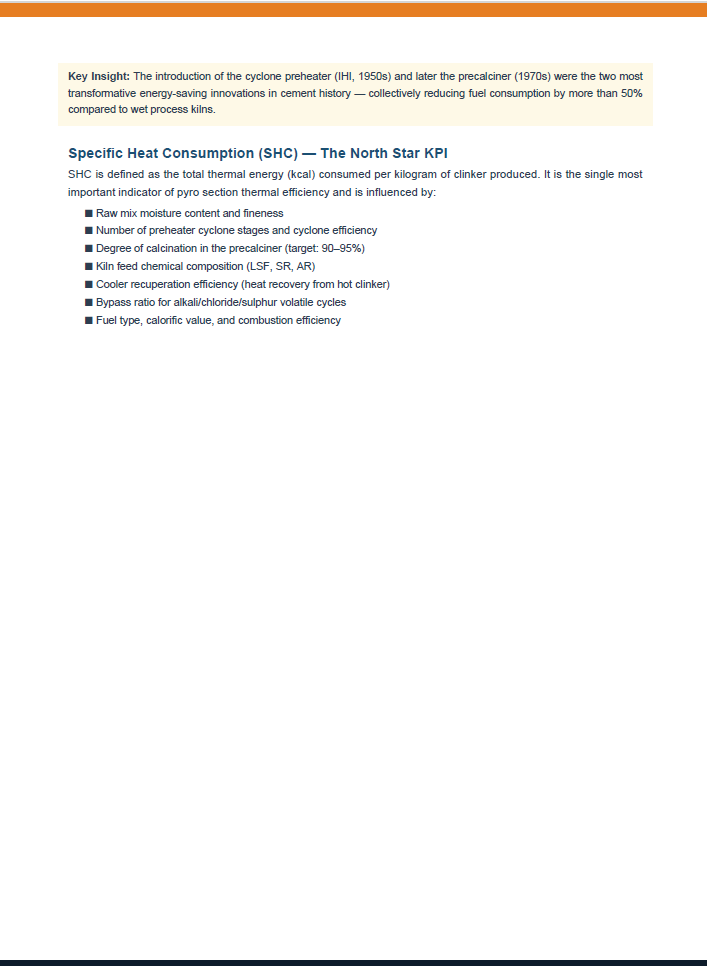
- Specific Heat Consumption (SHC):
Understand SHC as the most critical KPI for measuring kiln efficiency (kcal/kg clinker). - Benchmark Energy Values:
Learn modern plant targets (~650–760 kcal/kg clinker) and best-in-class performance (<630 kcal/kg). - Evolution of Energy Efficiency:
See how technology advancements reduced energy consumption by more than 50% from wet process to modern preheater-precalciner systems. - Game-Changing Innovations:
Importance of:- Cyclone Preheater
- Precalciner
in drastically improving thermal efficiency.
- Key Factors Affecting SHC:
Understand how operational and design parameters influence energy consumption, such as:- Raw mix quality & moisture
- Preheater efficiency
- Degree of calcination
- Fuel quality
- Cooler heat recovery
- Heat Recovery Importance:
Learn how recovering heat from clinker and exhaust gases significantly improves overall efficiency.
KEY PERFORMANCE INDICATORS (KPIs) FOR PYRO SECTION
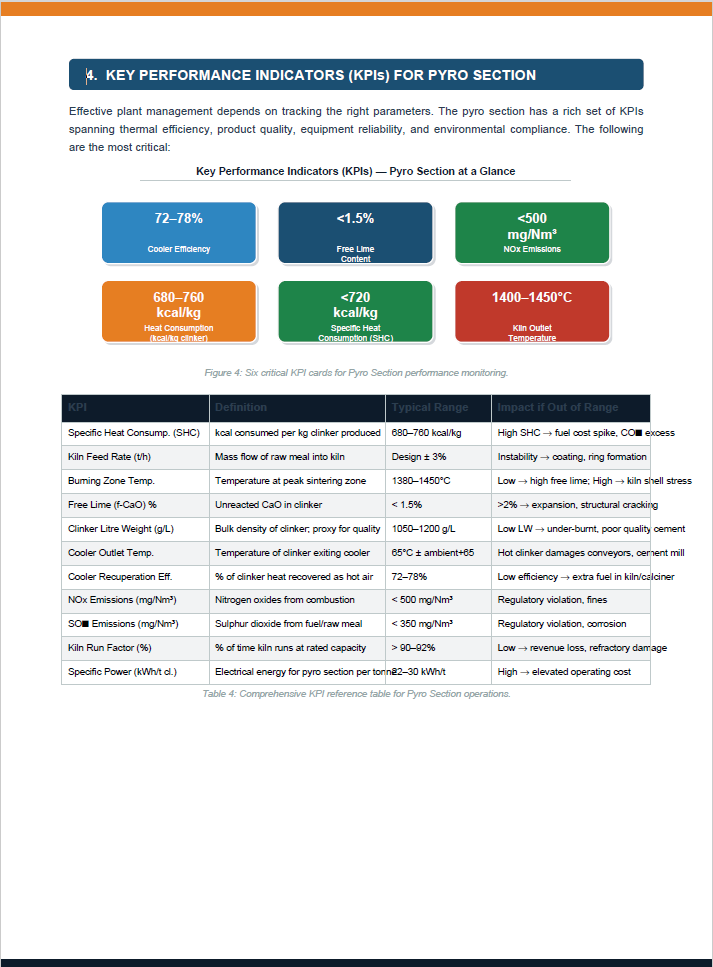
Key Concepts – Pyro Section KPIs & Performance Monitoring
- Importance of KPIs in Pyro Section:
Understand how performance monitoring ensures efficiency, product quality, equipment health, and environmental compliance. - Critical KPI Overview:
Learn the most important parameters such as:- Specific Heat Consumption (SHC)
- Kiln Temperature
- Cooler Efficiency
- Free Lime Content
- Emissions (NOx, SO₂)
- Specific Heat Consumption (SHC) as Core Metric:
Recognize SHC as the primary indicator of thermal efficiency and fuel performance. - Temperature Control Significance:
Understand how maintaining proper burning zone and kiln outlet temperatures directly impacts clinker formation and kiln life. - Clinker Quality Indicators:
Learn how:- Free Lime (f-CaO)
- Clinker Litre Weight
reflect clinker reactivity and cement performance.
- Cooler Performance & Heat Recovery:
Insight into cooler efficiency and clinker outlet temperature, and their role in energy savings and equipment safety. - Emission Control Awareness:
Understand limits for NOx and SO₂ emissions and their importance in meeting environmental regulations. - Operational Stability Metrics:
Learn about kiln feed rate and kiln run factor as indicators of process stability and plant productivity. - Impact of KPI Deviations:
Understand consequences like:- High fuel consumption
- Poor clinker quality
- Equipment damage
- Regulatory penalties
- Electrical Energy Performance:
Awareness of specific power consumption (kWh/t clinker) and its role in overall operating cost.
OVERVIEW OF MAJOR EQUIPMENT IN THE PYRO SECTION
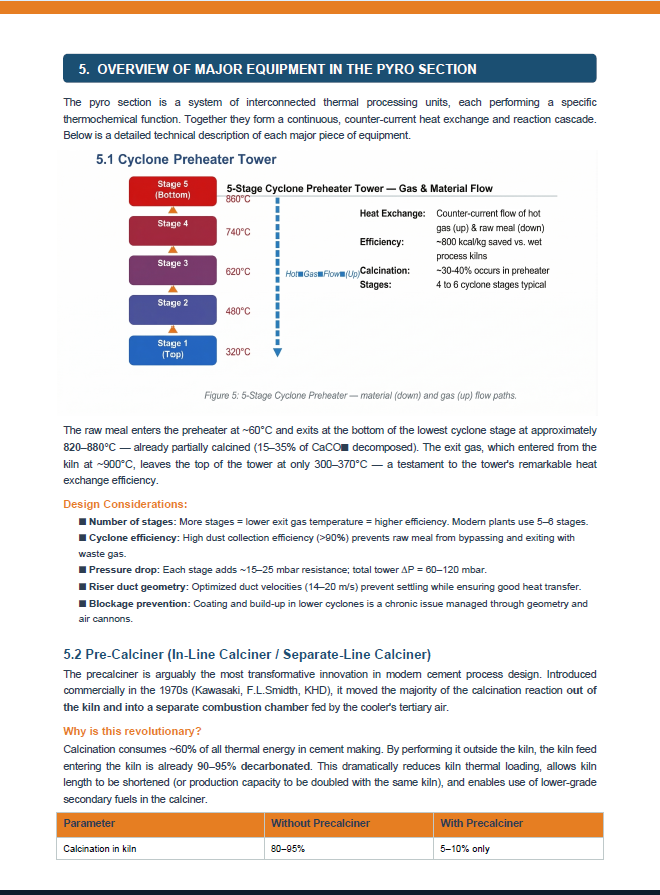
Key Concepts – Major Equipment in Pyro Section
- Integrated Thermal System Understanding:
Learn how the pyro section operates as a continuous, counter-current heat exchange system with interconnected equipment. - Cyclone Preheater Function & Efficiency:
Understand how multi-stage cyclone preheaters:- Preheat raw meal up to ~850°C
- Achieve partial calcination (15–40%)
- Significantly reduce fuel consumption through efficient heat recovery
- Counter-Current Heat Exchange Principle:
Insight into how hot gases flow upward while raw meal flows downward, maximizing heat transfer efficiency. - Precalciner – Game-Changing Innovation:
Learn how the precalciner:- Performs 90–95% calcination before kiln entry
- Reduces kiln load and fuel consumption
- Increases plant capacity and allows use of alternative fuels
- ILC vs SLC Calciner Designs:
Understand the difference between In-Line Calciner and Separate-Line Calciner and their operational advantages. - Rotary Kiln – Heart of Clinker Formation:
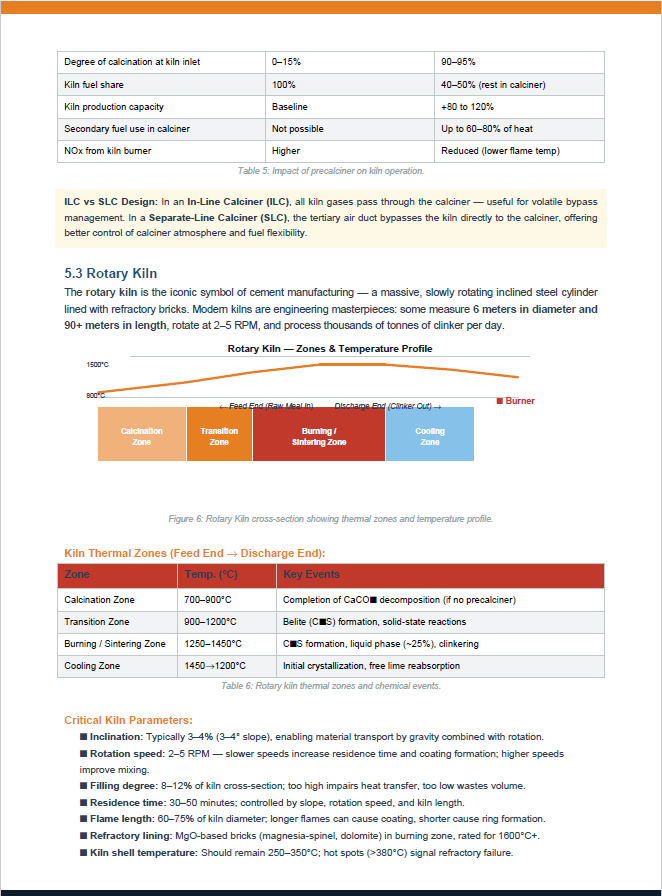
Detailed understanding of kiln operation including:- Thermal zones (calcination, transition, sintering, cooling)
- Temperature profile up to ~1450°C
- Key reactions forming clinker minerals
- Critical Kiln Operating Parameters:
Learn how factors like:- Kiln speed
- Inclination
- Residence time
- Flame characteristics
impact clinker quality and kiln stability.
- Refractory & Kiln Health:
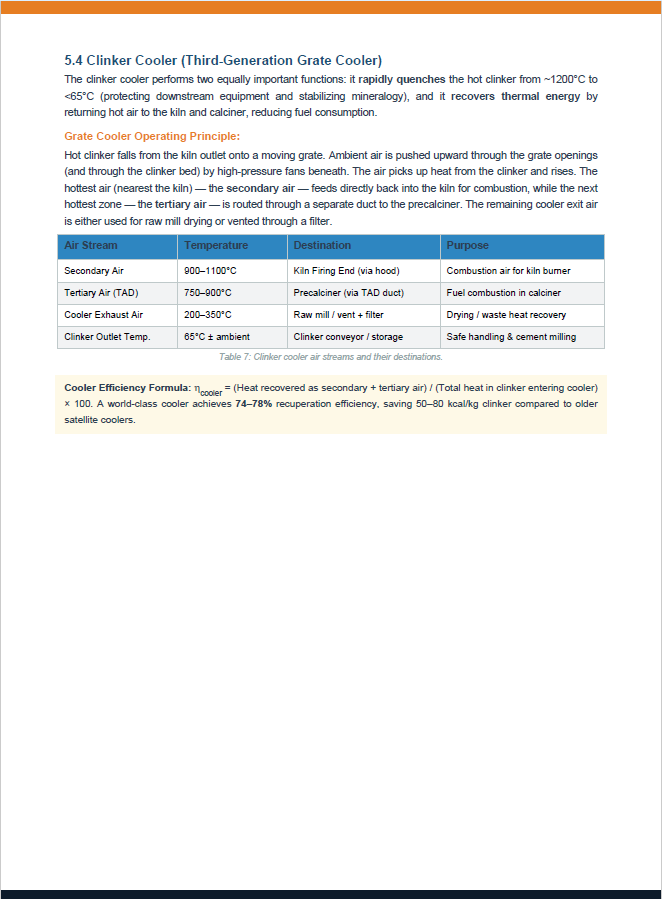
Awareness of refractory lining importance and how shell temperature indicates kiln condition. - Clinker Cooler Role & Working Principle:
Understand how the grate cooler:- Rapidly cools clinker
- Stabilizes mineral structure
- Protects downstream equipment
- Heat Recovery Through Air Streams:
Learn how different air streams are reused:- Secondary air → kiln combustion
- Tertiary air → precalciner
- Exhaust air → drying or venting
- Cooler Efficiency & Energy Savings:
Understand how high cooler efficiency (74–78%) directly reduces fuel consumption and improves overall plant efficiency.
OPERATIONAL CHALLENGES & OPTIMIZATION STRATEGIES
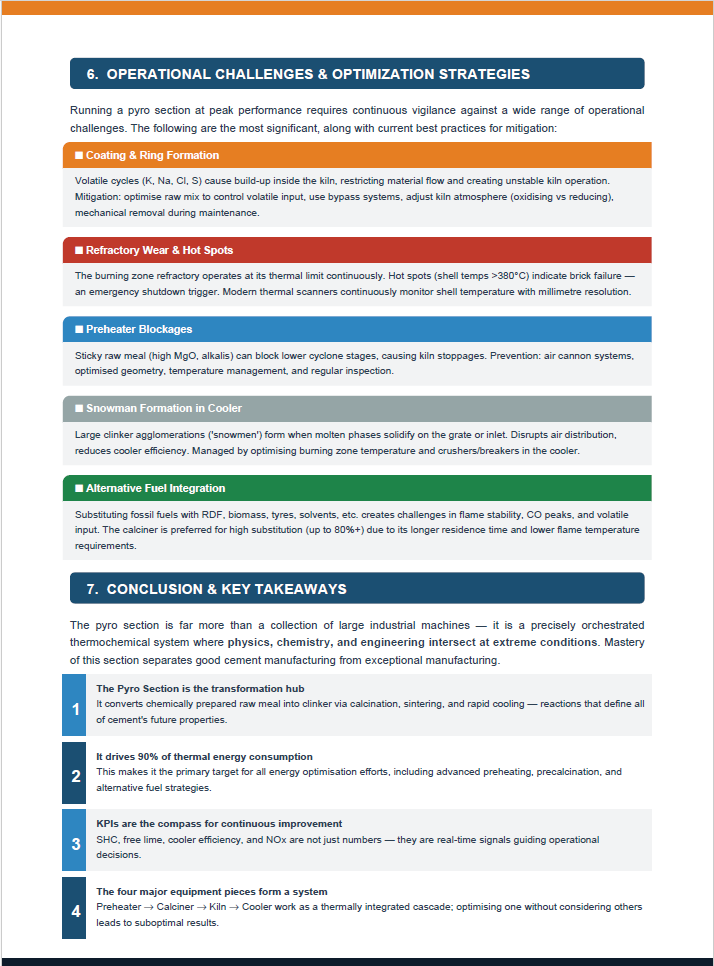
Key Concepts – Operational Challenges & Optimization in Pyro Section
- Understanding Real Operational Challenges:
Learn about common issues like coating, ring formation, preheater blockages, refractory wear, and cooler “snowman” formation. - Volatile Cycle Impact (K, Na, Cl, S):
Understand how alkali and sulphur cycles lead to internal build-ups, affecting kiln stability and throughput. - Refractory Health & Hot Spot Monitoring:
Learn the importance of kiln shell temperature monitoring and how hot spots signal refractory failure and potential shutdowns. - Preheater Blockage Prevention:
Insight into causes (sticky raw meal, high alkalis) and solutions like air cannons, optimized design, and process control. - Cooler Performance Issues (Snowman Formation):
Understand how clinker agglomeration disrupts airflow and reduces cooling efficiency, and how it can be controlled. - Alternative Fuel Utilization Challenges:
Learn the complexities of using RDF, biomass, tyres, etc., and why the calciner is ideal for high fuel substitution. - Optimization Strategies for Stable Operation:
Practical approaches including:- Raw mix optimization
- Kiln atmosphere control
- Use of bypass systems
- Preventive maintenance
Chemistry of Cement Clinker Formation
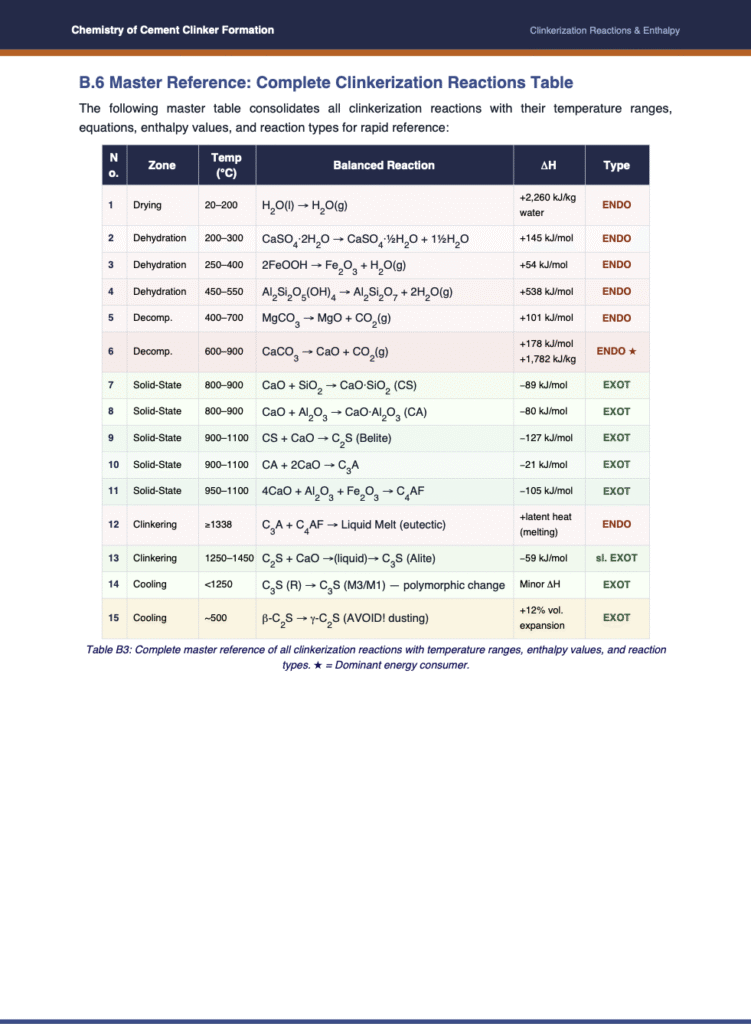
CLINKERIZATION REACTION
Key Concepts
- Understanding of clinker formation process from raw meal to final product
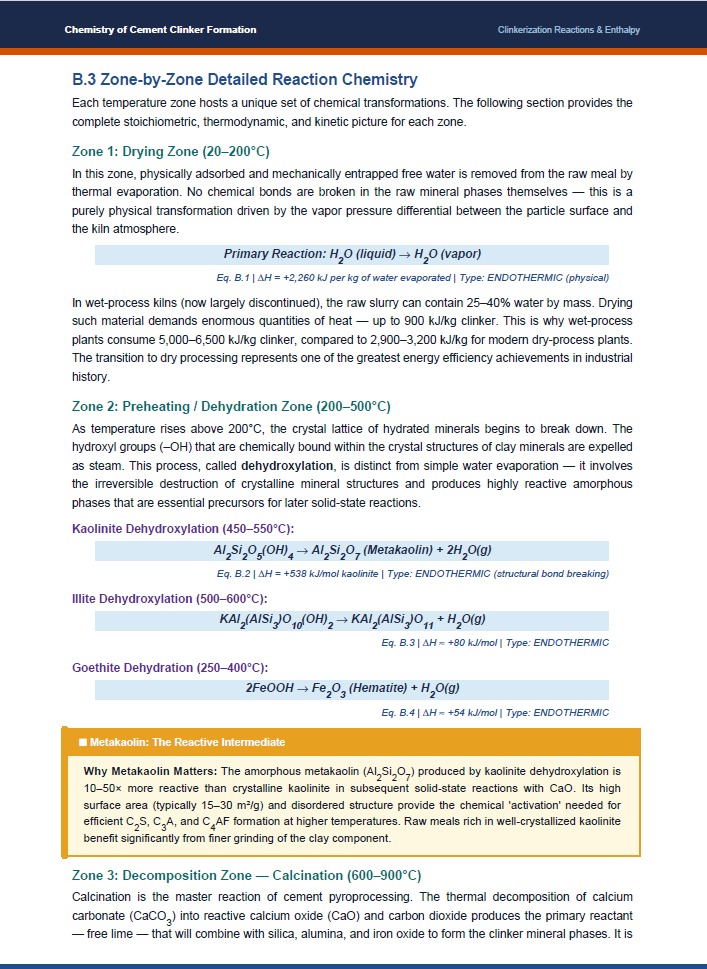
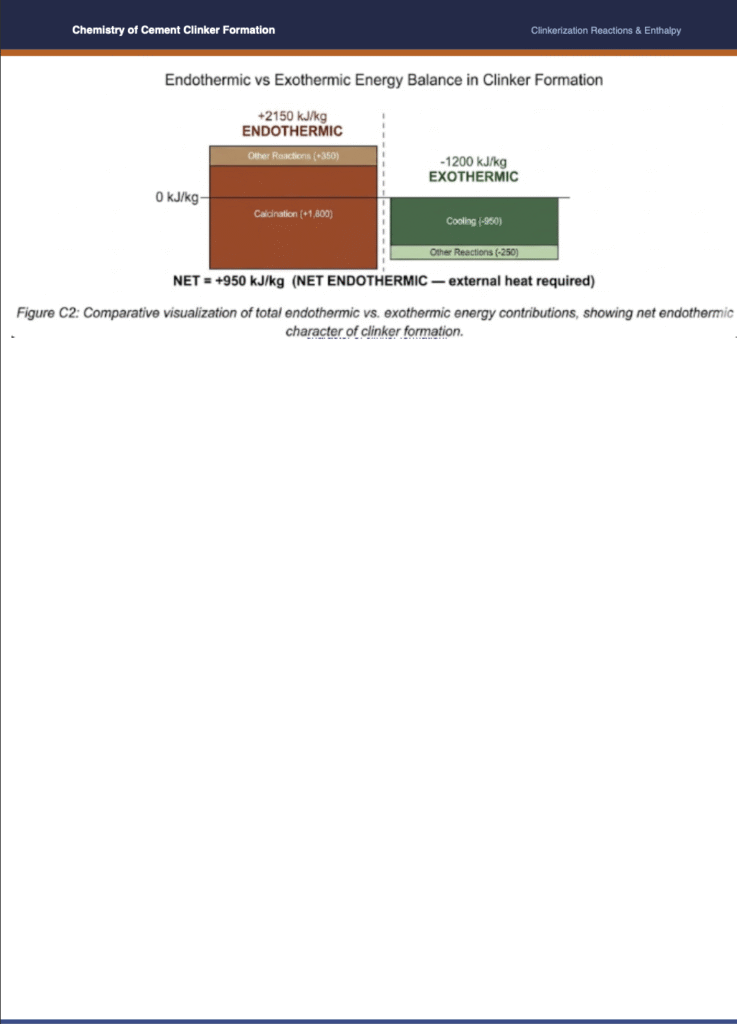
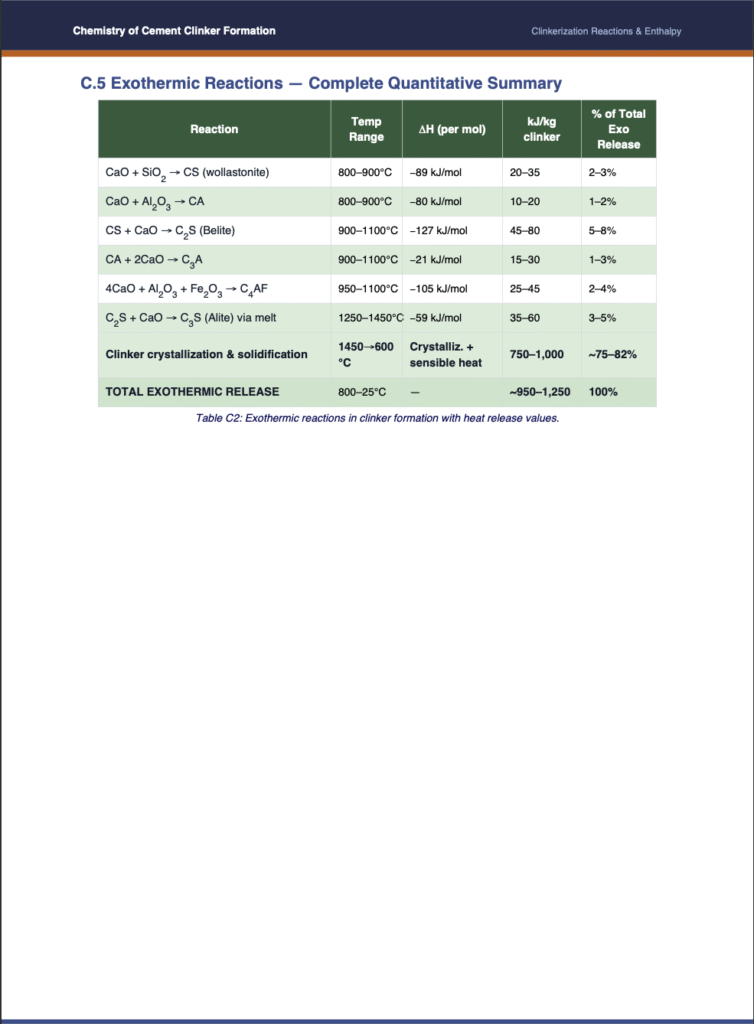
- Role of temperature and heat reactions (endothermic & exothermic)
- Stepwise formation of major clinker phases: C₂S, C₃S, C₃A, C₄AF
- Importance of calcination (CaCO₃ → CaO + CO₂)
- Significance of liquid phase formation in the burning zone
- Role of Alite (C₃S) in cement strength
- Impact of cooling rate on clinker quality
- Overview of rotary kiln zones and reactions
Reaction Kinetics and Rate-Controlling Mechanisms
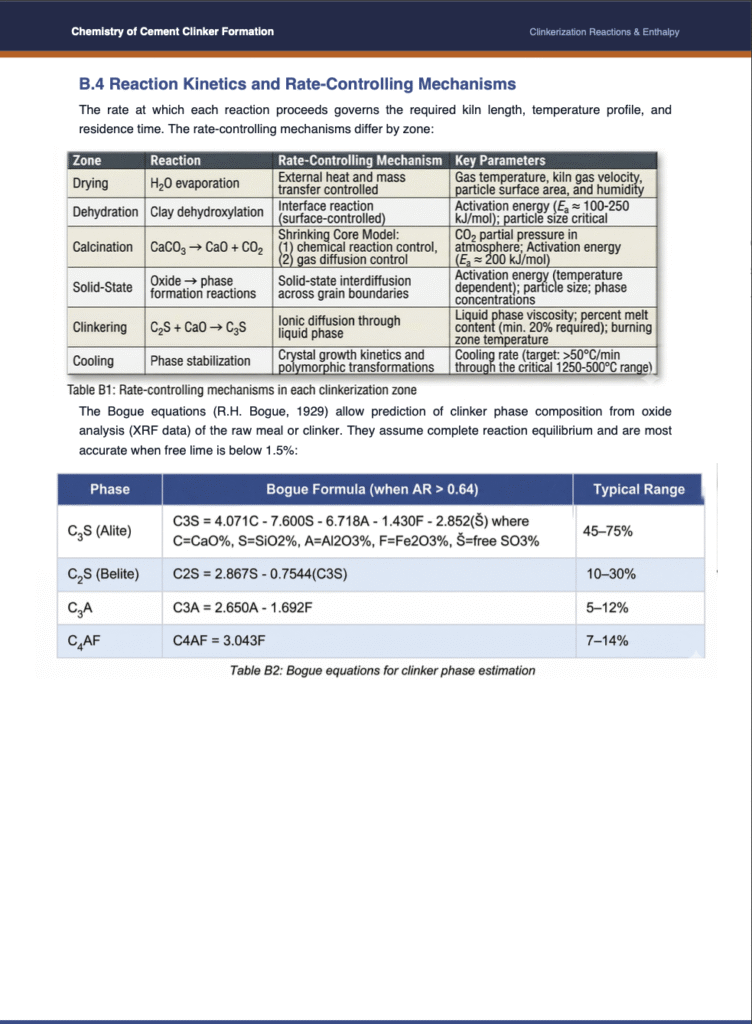
Endothermic vs Exothermic Energy Balance in Clinker Formation
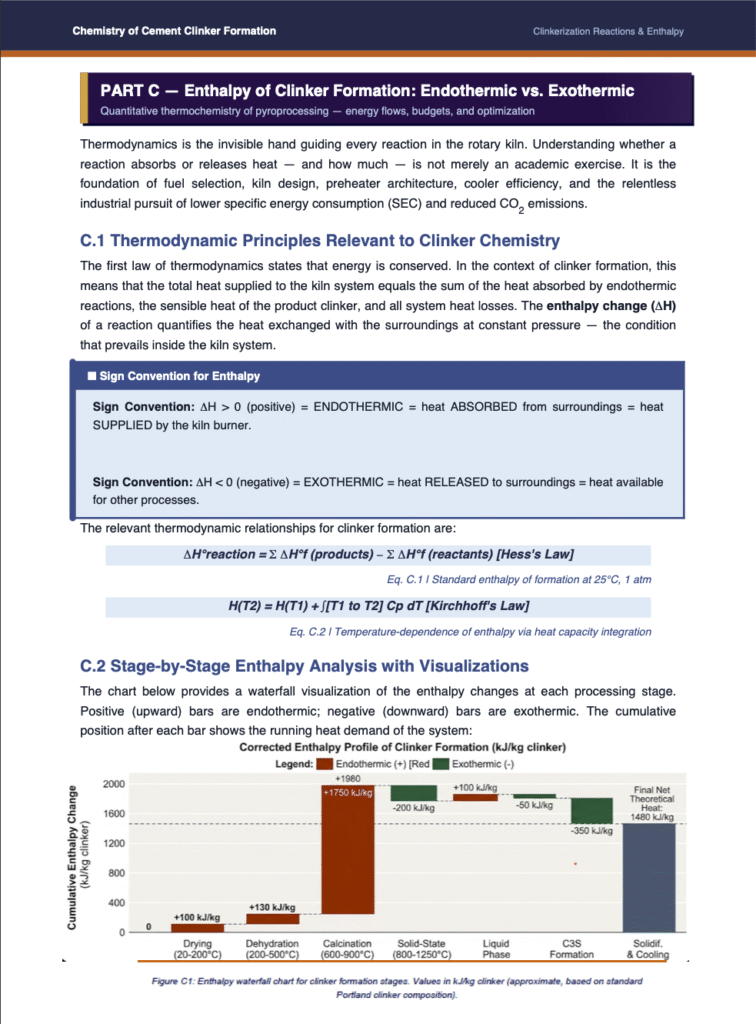
Endothermic Reactions
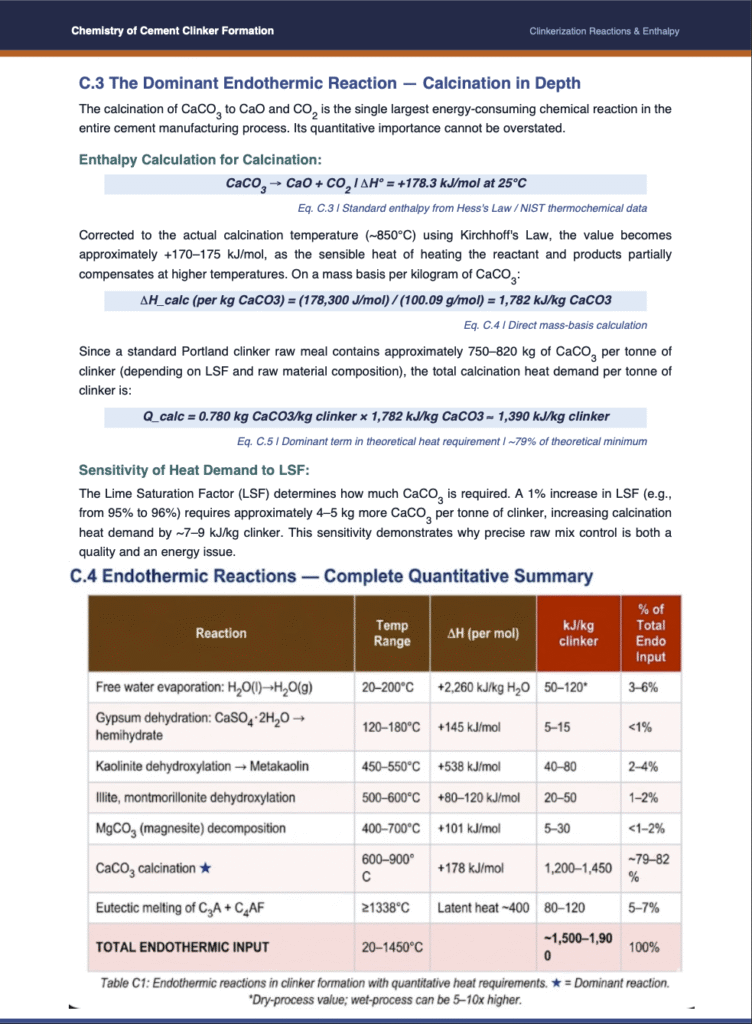
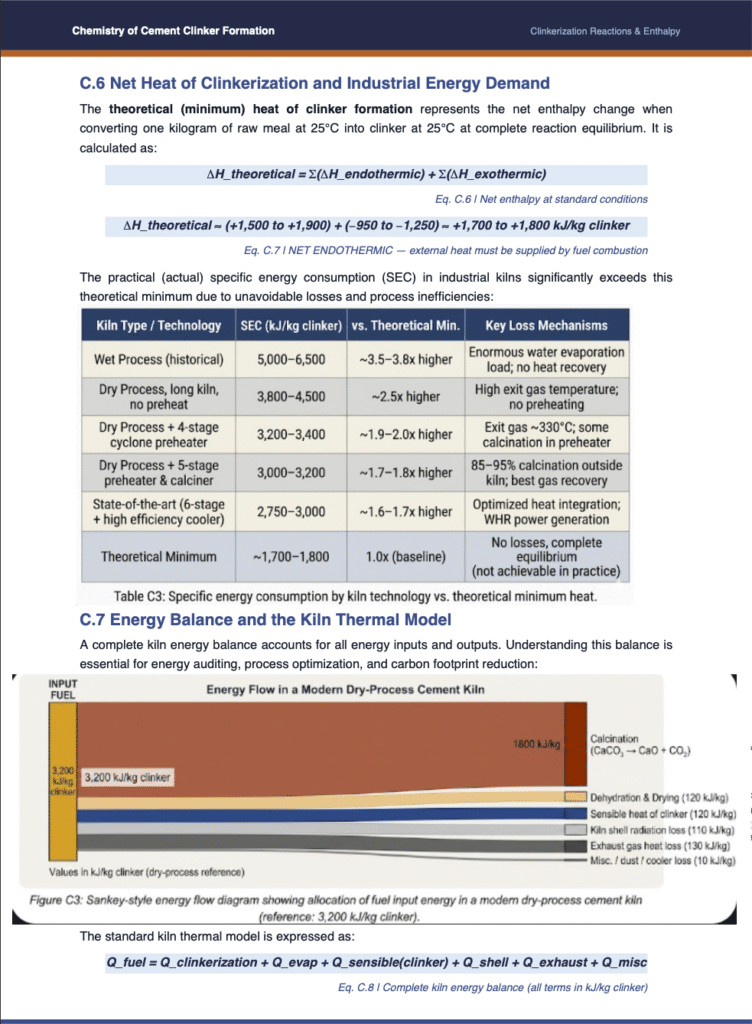
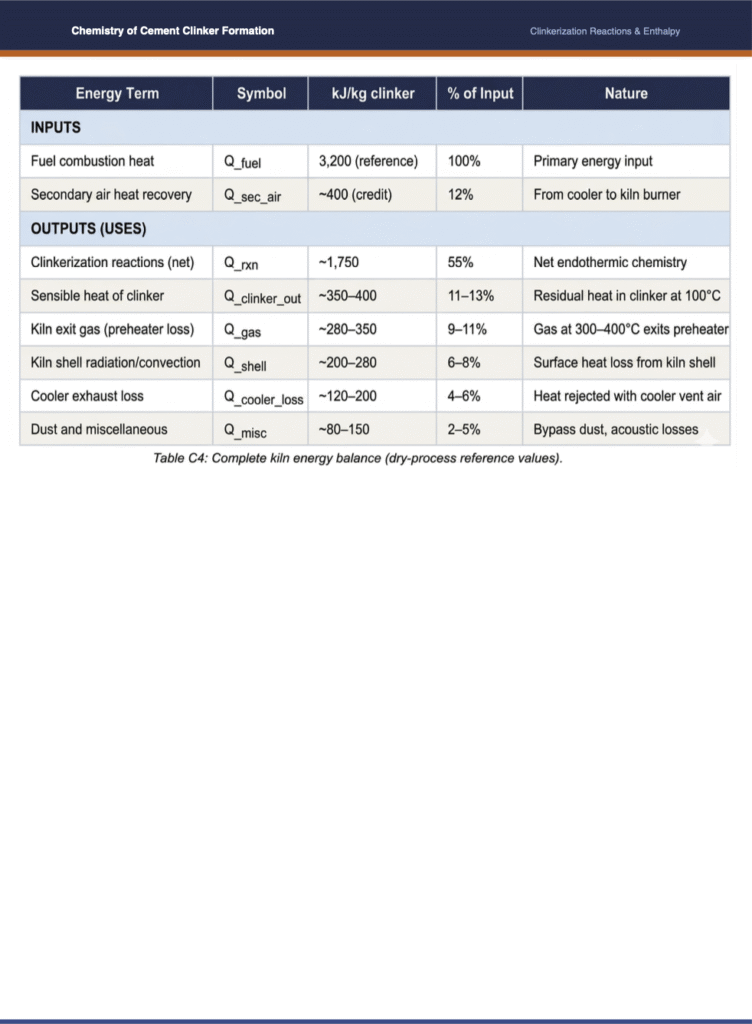
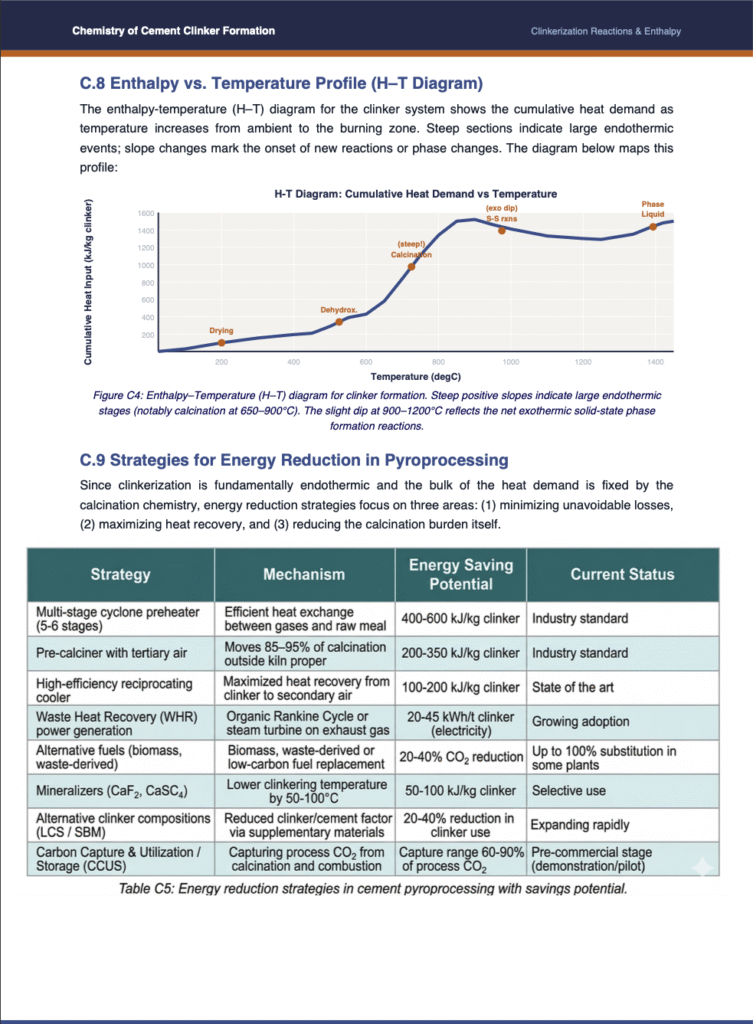
Net Heat of Clinkerization and Industrial Energy Demand