chatgpt image mar 17, 2026, 07 42 24 pm

Complete Micro-Topic Blueprint of Ball Mill

Ball Mills are the heart of grinding systems across cement, mining, and mineral processing industries. Despite being one of the oldest technologies, their performance still defines plant efficiency, energy consumption, and product quality. This section is designed as a complete technical resource—covering everything from fundamentals to real plant data, calculations, troubleshooting, and optimization strategies used by industry professionals.

In this section, you will find: Fundamental concepts of ball mill grinding Design and sizing calculations Operational parameters and their impact Case studies from real plants Troubleshooting and optimization techniques Downloadable technical sheets and reports

BALL MILL : FUNDAMENTALS AND ITS PLACE IN THE CEMENT PROCESS

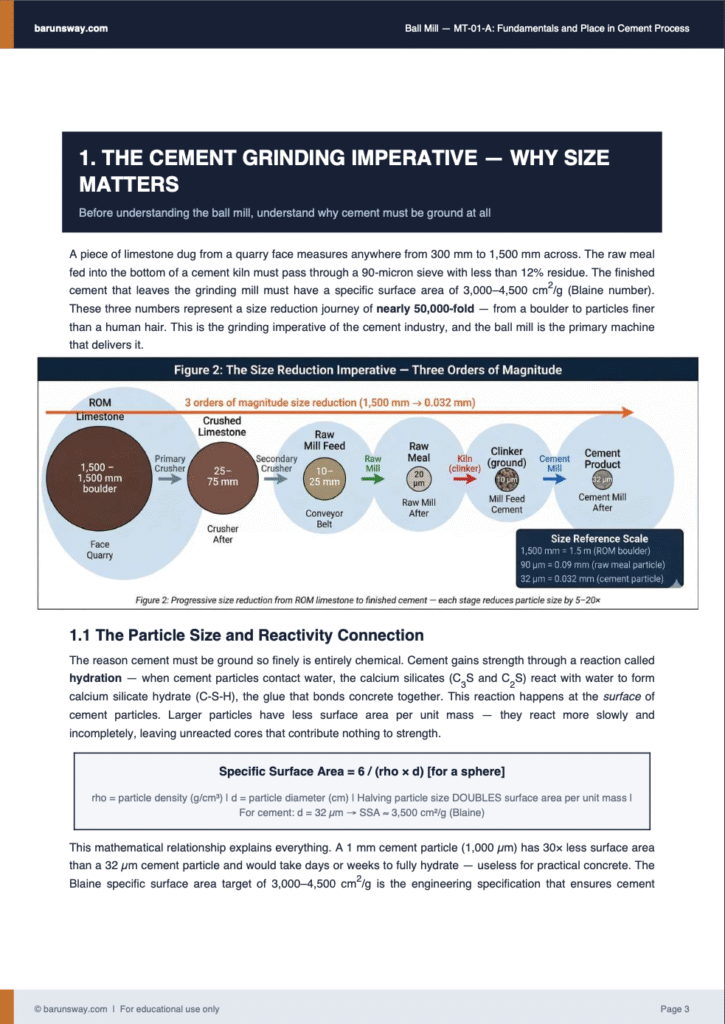
Topic -1 : THE CEMENT GRINDING IMPERATIVE — WHY SIZE MATTERS
screenshot 2026 03 29 at 10.20.19 pm
screenshot 2026 03 29 at 10.21.23 pm
w1

Fundamentals

This chapter introduces the core principles behind ball mill operation and its role in cement grinding.


What You Will Learn

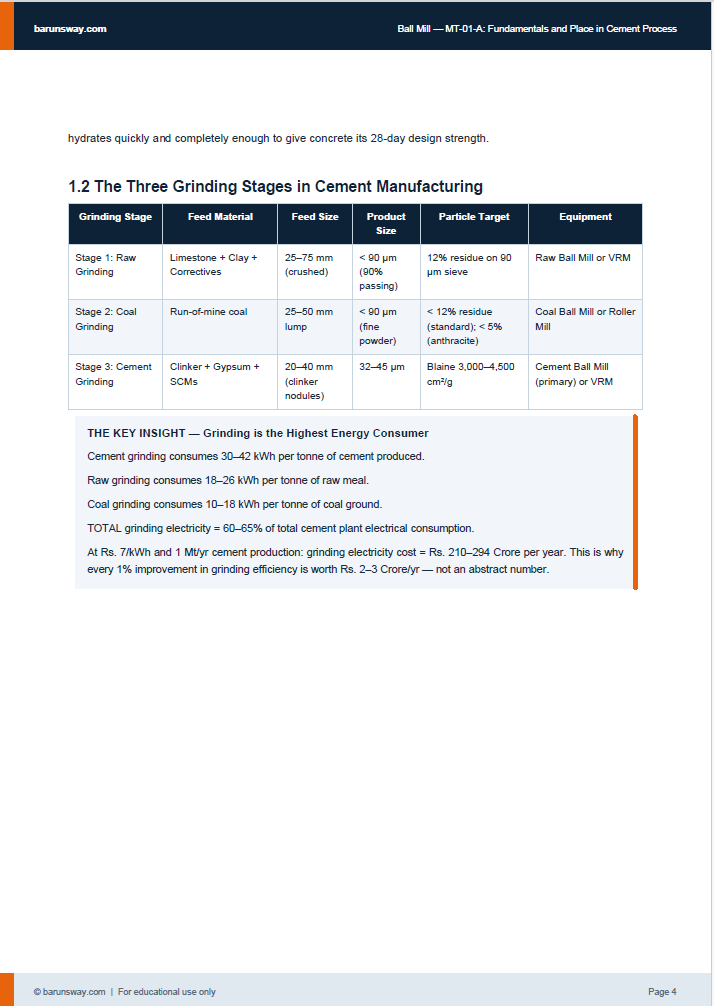
  • Why grinding is essential in cement manufacturing and how particle size affects strength and reactivity
  • What a ball mill is and its role as a primary grinding equipment
  • Basic internal structure of a ball mill (chambers, liners, diaphragm)
  • Grinding mechanisms – impact and attrition
  • Ball motion inside the mill and the concept of critical speed
  • Where ball mills are used in the cement process (raw, coal, cement grinding)
  • Energy importance of grinding, as it consumes a major share of plant power

Outcome

Build a strong foundation to understand how ball mills function and why they are critical to cement plant performance.

screenshot 2026 03 29 at 10.20.19 pm
topic 2
what is ball mill

Key Concepts You Will Learn

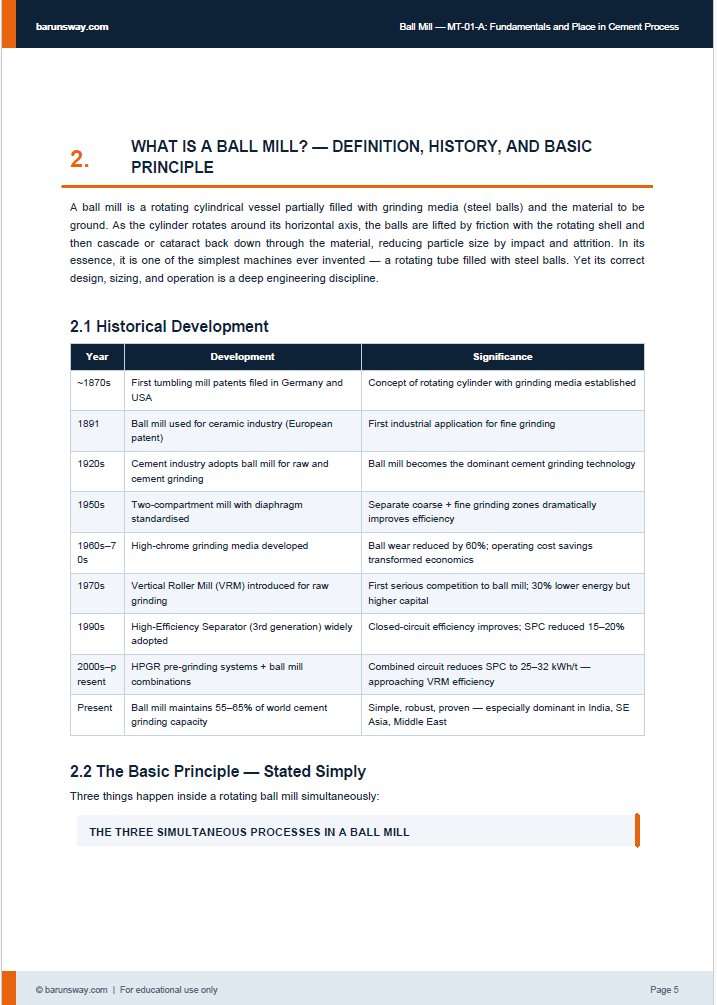
  • Definition of a Ball Mill
    A rotating cylindrical grinding system where steel balls reduce material size through impact and attrition.
  • Basic Working Principle
    Material is ground as grinding media are lifted and then fall (cascading/cataracting) inside the rotating shell.
  • Three Simultaneous Processes Inside the Mill
    • Size Reduction – Particle breakage due to impact between balls and liners
    • Internal Classification – Diaphragm controls movement of material between compartments
    • Material Transport – Airflow (ventilation) carries fine particles toward discharge
  • Nip Condition in Grinding
    Effective grinding occurs only when particle size is appropriate relative to ball size to allow proper fracture.
  • Role of Ventilation
    Essential to prevent cushioning effect, where fine particles coat media and reduce grinding efficiency.
  • Evolution of Ball Mill Technology
    From early tumbling mills to modern systems with:
    • Multi-compartment design
    • High-efficiency separators
    • Pre-grinding technologies (HPGR)
  • Industrial Relevance
    Despite newer technologies, ball mills remain widely used due to their simplicity, robustness, and adaptability.
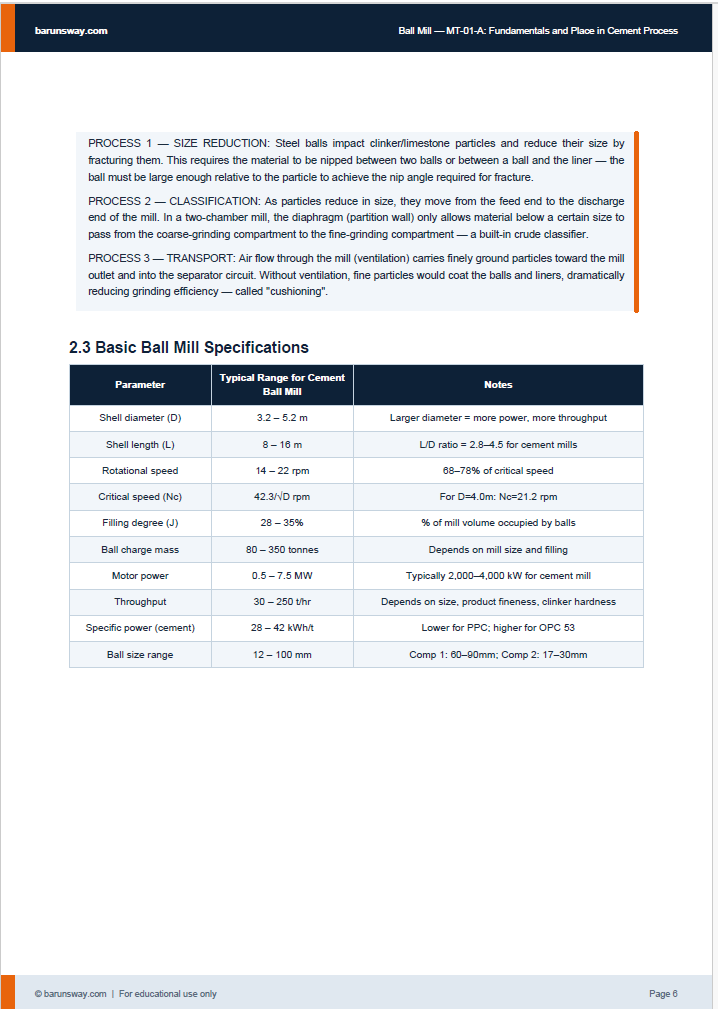
  • Key Design & Operating Parameters
    • Mill dimensions (diameter & length)
    • Critical speed vs operating speed
    • Ball charge and filling degree
    • Throughput and specific power consumption
screenshot 2026 03 29 at 10.20.19 pm
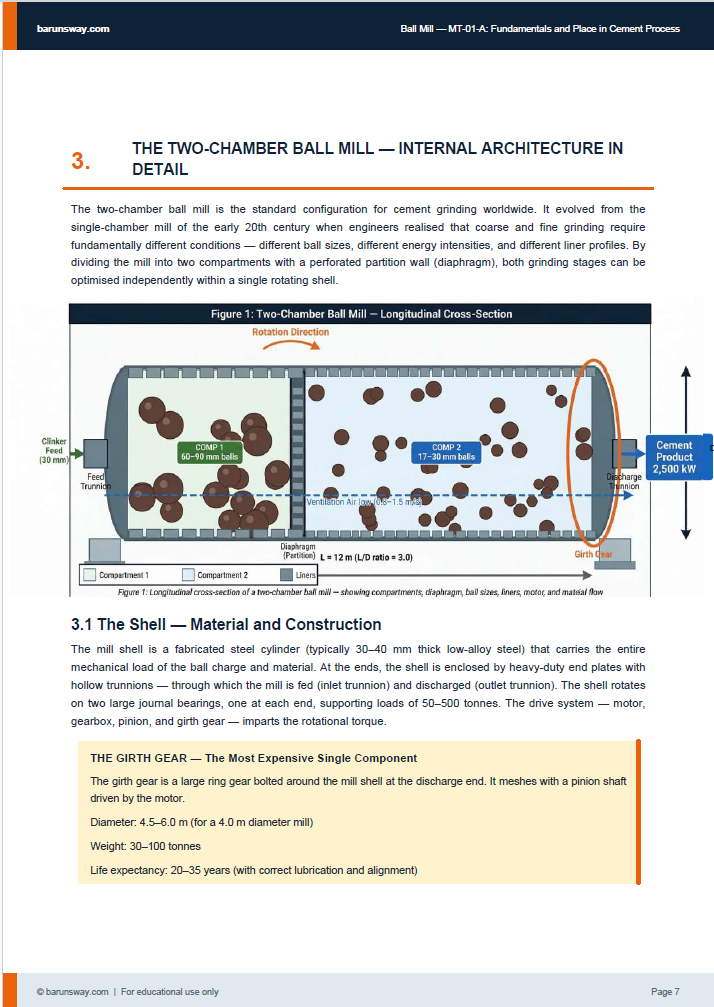
ball mill internal architecture
ball mill internal architecture2
ball mill internal architecture3

Key Concepts You Will Learn

  • Why Two Chambers?
    Understanding how separating the mill into two compartments improves grinding efficiency by handling coarse and fine grinding differently.
  • Ball Size & Grinding Mechanism
    How larger balls in the first chamber provide impact grinding, while smaller balls in the second chamber enable fine grinding.
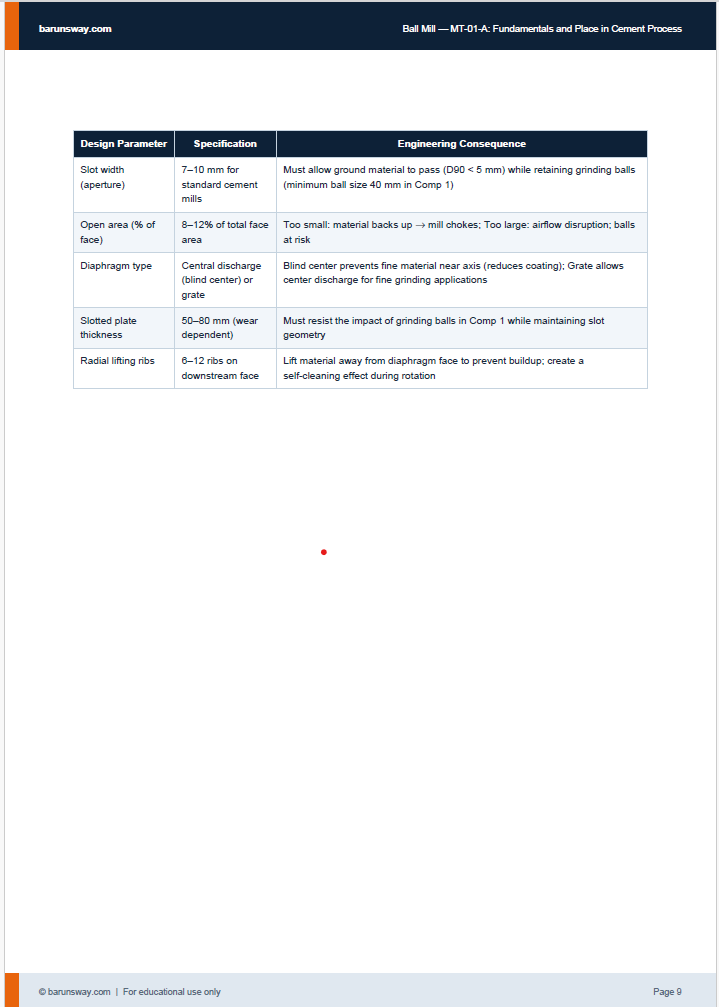
  • Role of the Diaphragm
    How the intermediate diaphragm controls material flow, ensures proper segregation of grinding media, and maintains grinding efficiency.
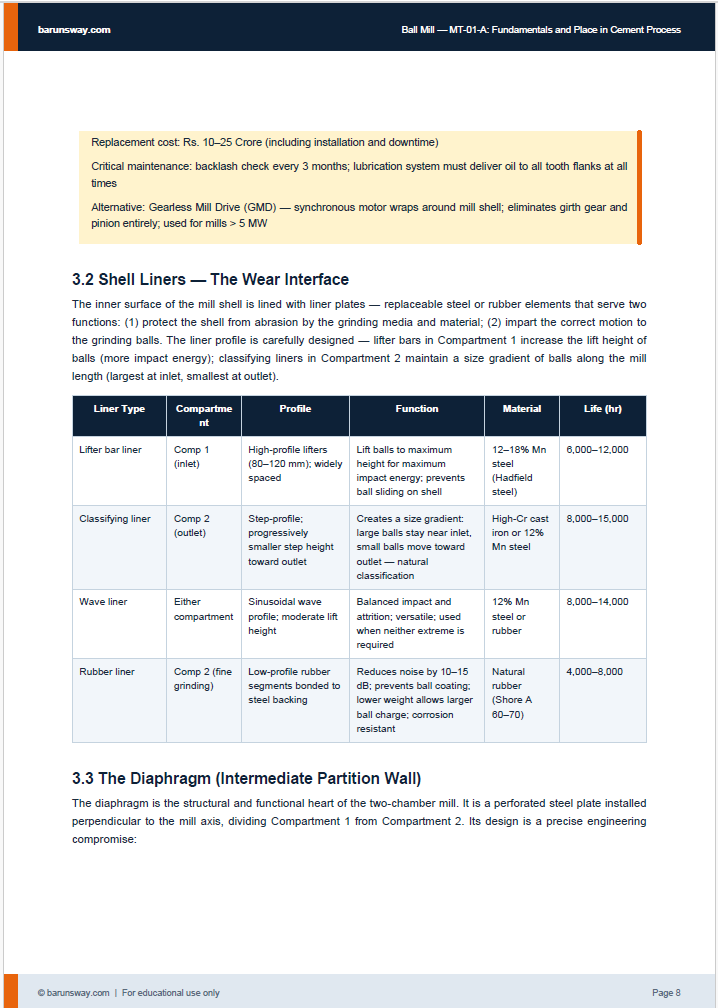
  • Mill Shell Fundamentals
    Insights into the shell’s construction, load-bearing role, and how it supports the entire grinding process.
  • Girth Gear Importance
    Why the girth gear is the most critical and expensive component, and its role in transmitting power to the mill.
  • Liner Function & Types
    How liners protect the shell and influence grinding performance, including lifter, classifying, wave, and rubber liners.
  • Material Movement Inside the Mill
    Understanding how material progresses from coarse to fine along the mill length.
  • Design Parameters That Matter
    Key diaphragm design factors like slot size, open area, and plate thickness—and how they affect performance.
  • Ventilation & Flow Control
    The importance of airflow in transporting material and maintaining efficient grinding conditions.
  • Engineering Trade-offs
    How mill design balances impact, attrition, material flow, and durability for optimal operation.
screenshot 2026 03 29 at 10.20.19 pm
grinding mechanism 1
grinding mechanism 2

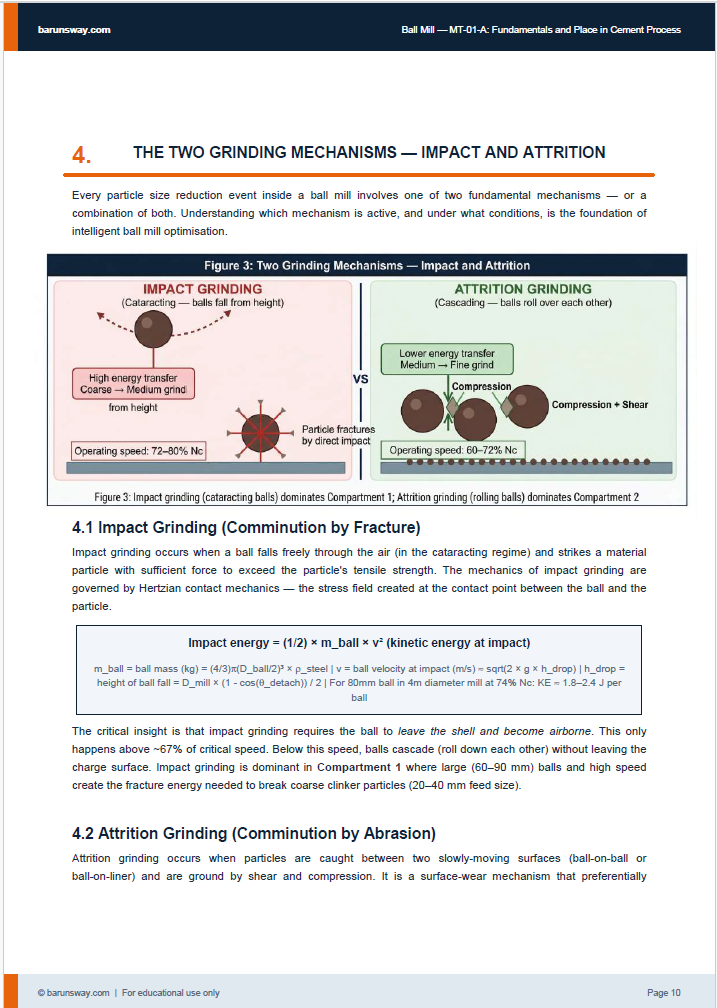
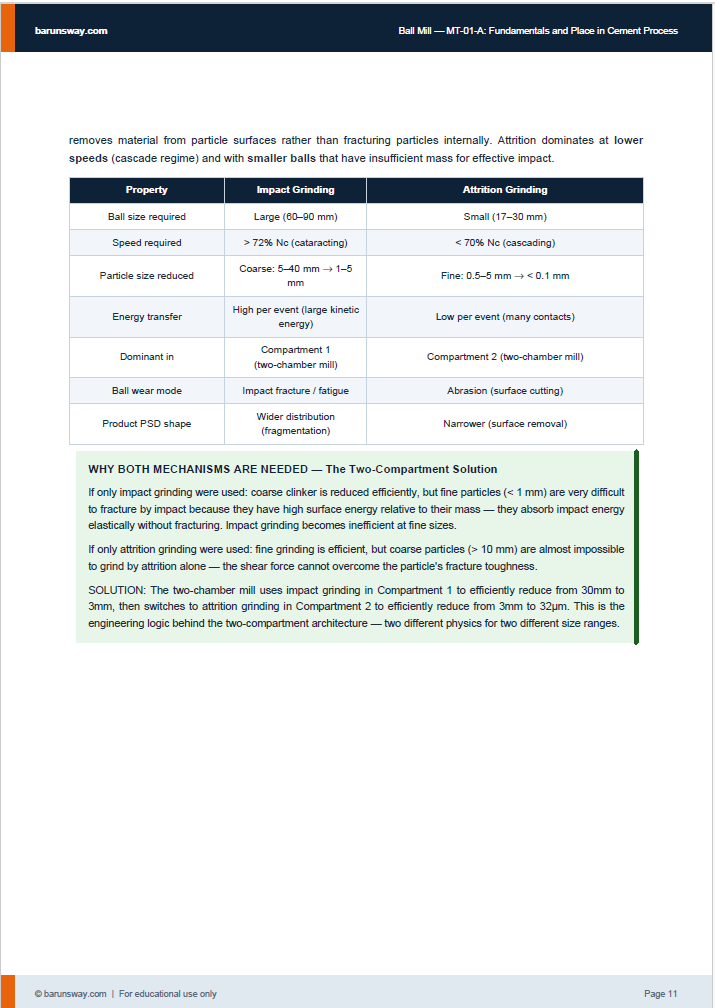
Key Concepts – Impact vs Attrition Grinding

1. Two Fundamental Grinding Mechanisms

  • Ball mills operate using two primary mechanisms:
    • Impact Grinding (Fracture)
    • Attrition Grinding (Abrasion)
  • Real grinding is usually a combination of both, depending on operating conditions.

2. Impact Grinding – High Energy Breakage

  • Occurs when balls fall from height (cataracting) and strike particles.
  • Dominates at higher speeds (> ~72% of critical speed).
  • Generates high energy per impact, causing particle fracture.
  • Most effective for:
    • Coarse feed (20–40 mm clinker)
    • Initial size reduction
  • Controlled by kinetic energy (½mv²) and drop height.

3. Attrition Grinding – Surface Wear Mechanism

  • Occurs when balls roll over each other (cascading).
  • Dominates at lower speeds (< ~70% of critical speed).
  • Produces fine grinding through shear and compression.
  • Most effective for:
    • Fine particles (< 1 mm)
    • Final product refinement
  • Removes material layer by layer (surface abrasion) rather than breaking it.

4. Critical Speed Defines Grinding Behavior

  • Around ~67% Nc is the transition point:
    • Below → Cascading → Attrition
    • Above → Cataracting → Impact
  • Proper speed selection is key to mill performance optimization.

5. Ball Size Determines Grinding Mode

  • Large balls (60–90 mm) → Impact grinding → Coarse reduction
  • Small balls (17–30 mm) → Attrition grinding → Fine grinding
  • Ball size distribution directly controls grinding efficiency and product quality.

6. Energy Distribution Difference

  • Impact: High energy, fewer events
  • Attrition: Low energy, many contacts
  • Efficient grinding requires a balance of both energy modes.

7. Compartment-wise Grinding in Ball Mills

  • Compartment 1:
    • Large balls
    • High speed
    • Impact-dominated
    • Reduces size from ~30 mm → ~3 mm
  • Compartment 2:
    • Smaller balls
    • Lower speed
    • Attrition-dominated
    • Refines from ~3 mm → fine powder

8. Why Both Mechanisms Are Necessary

  • Only impact:
    • Inefficient for fine grinding (particles absorb energy elastically)
  • Only attrition:
    • Cannot break coarse particles effectively
  • Therefore, two-compartment design is essential for full grinding efficiency.

9. Product Quality Impact

  • Impact grinding → Wider particle size distribution
  • Attrition grinding → Narrower, finer distribution
  • Final product quality depends on proper transition between both mechanisms.
topic 5
topic 51
topic 52

Key Concepts: 

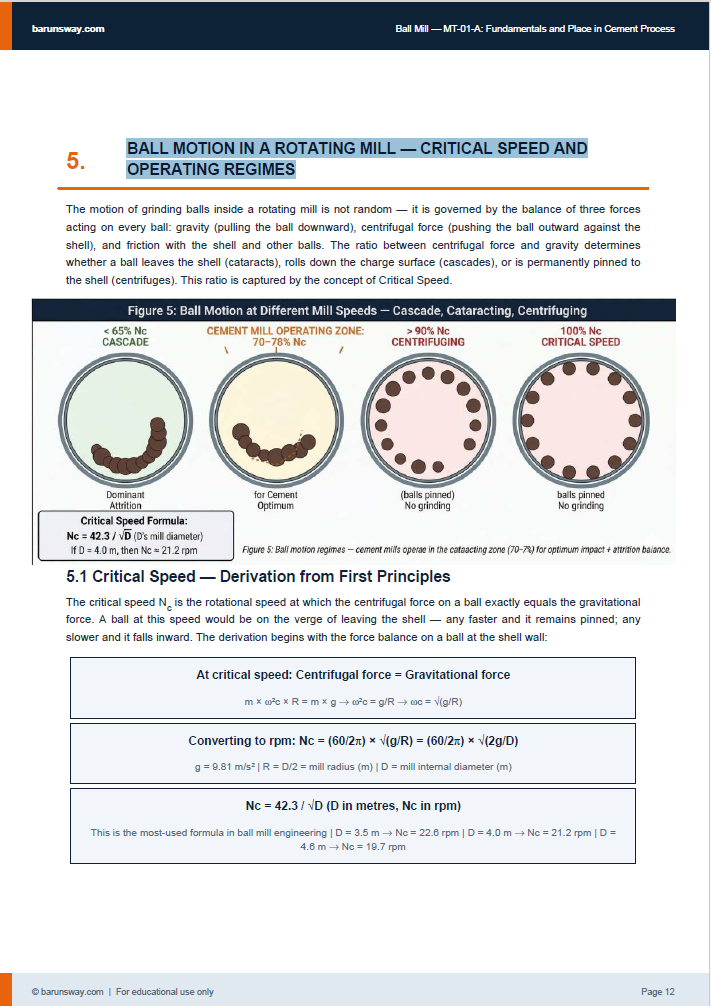
  • Ball Motion is Force-Driven

    Ball movement inside the mill is governed by the balance between gravity, centrifugal force, and friction.

  • Critical Speed Definition

    Critical speed is the point where centrifugal force equals gravitational force, causing balls to remain pinned to the shell.

  • Critical Speed Formula

    Nc = 42.3 / √D (D in metres)

    → A fundamental design equation used in ball mill engineering.

  • Dependence on Mill Diameter

    Critical speed depends only on mill diameter, not on ball size, material, or filling degree.

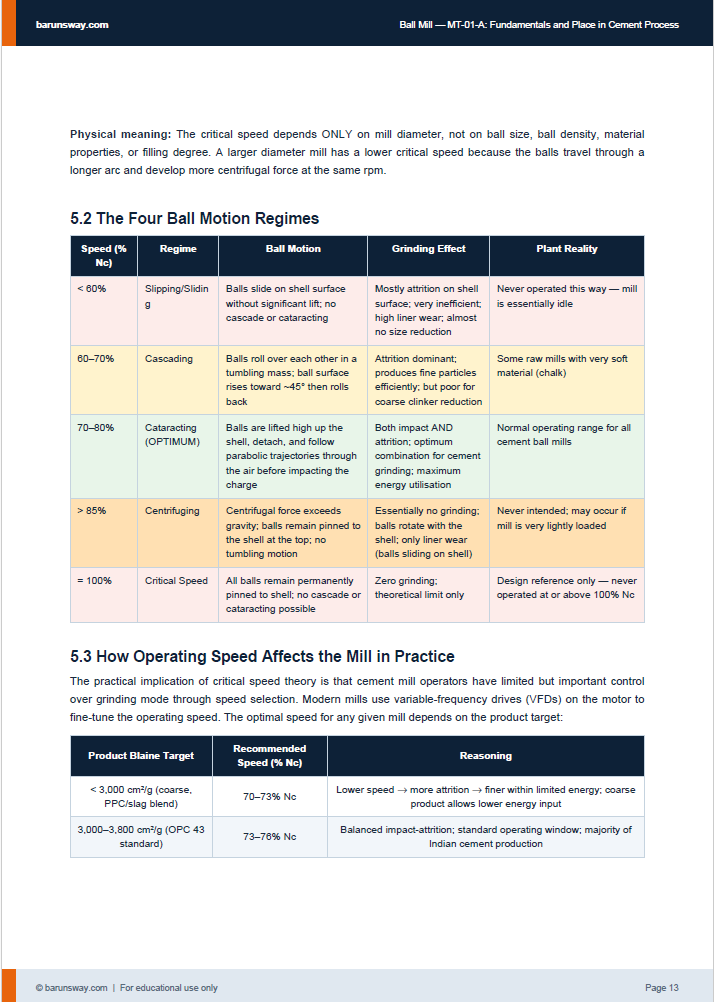
  • Ball Motion Regimes

    Four distinct regimes based on % of critical speed:

    • < 60% Nc: Sliding (inefficient, no grinding)

    • 60–70% Nc: Cascading (attrition dominant)

    • 70–80% Nc: Cataracting (optimum grinding)

    • > 85% Nc: Centrifuging (no grinding)

  • Optimum Operating Zone

    Cement mills operate in the 70–78% Nc range, where both impact and attrition are effectively utilized.

  • Grinding Mechanisms

    • Cascading → mainly attrition

    • Cataracting → combination of impact and attrition (most effective)

  • Effect of Speed on Grinding

    Mill speed directly controls ball trajectory, energy transfer, and grinding efficiency.

  • Practical Speed Control

    Modern mills use VFD (Variable Frequency Drives) to adjust speed based on product requirements.

  • Speed vs Product Fineness

    • Lower speed → suitable for coarser products

    • Higher speed → required for finer grinding and high Blaine cement

  • Operational Limits

    • Near or at 100% Nc → zero grinding

    • Centrifuging condition must be avoided in practice